
Journeys
Design customer moments around intent, next action and completion—not around departments.
Enterprise transformation
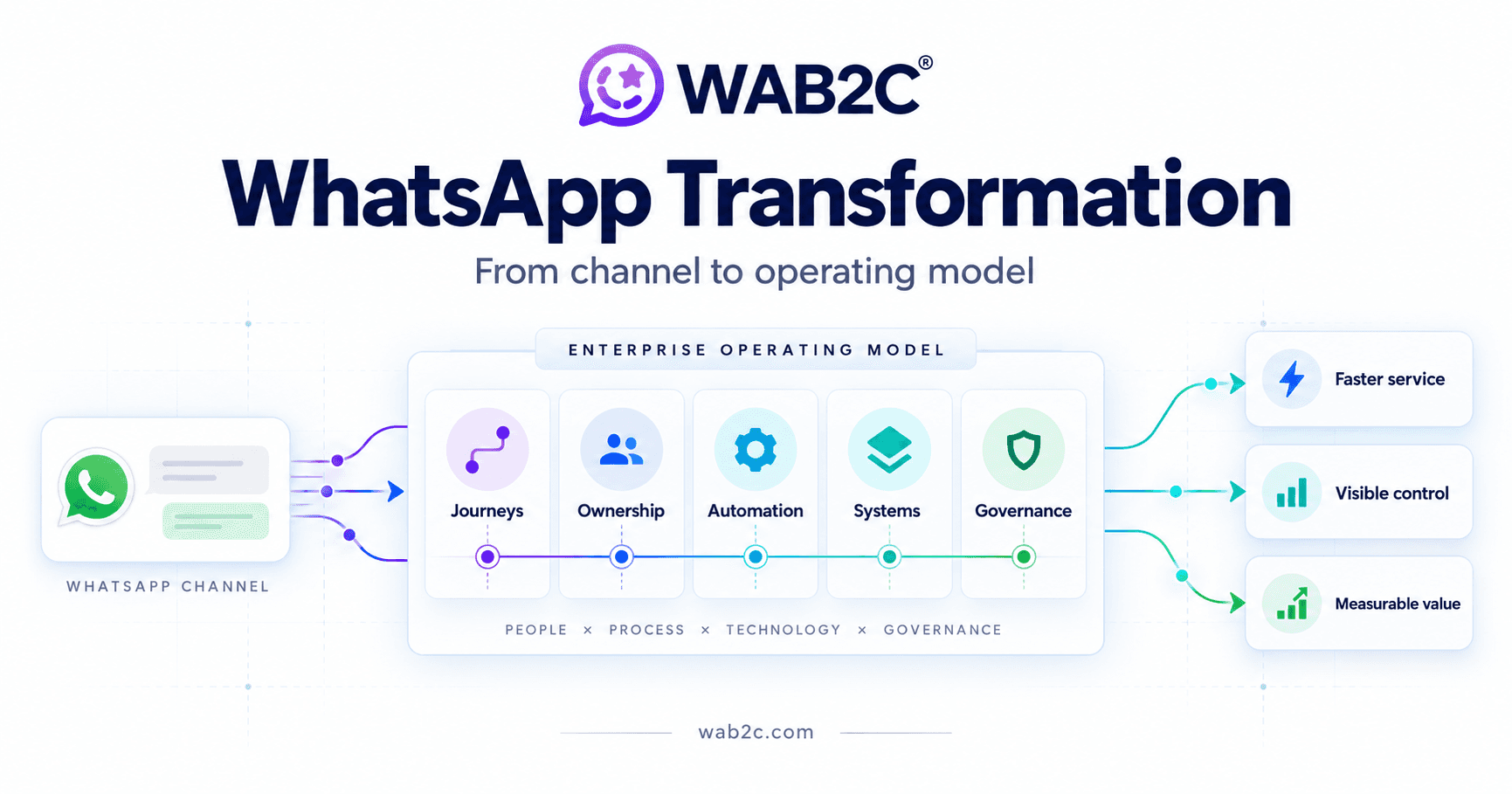
Redesign the journeys, ownership, automation, systems and controls that turn customer conversations into accountable enterprise work.
Business outcome before feature scope
One owner for every journey
Human control at critical decisions
Evidence before enterprise scale
Transformation control map
Channel activity → enterprise capability → business outcome
Customer demand
Enquiries, service, payments, orders and exceptions.
Operating core
Journey
Owner
System
Control
Business outcome
Completion, service, control and value.
Assess
Design
Pilot
Scale
Improve
Transformation maturity
Select a stage to see the operating evidence, management question and next decision that matter.
Current operating signal
WhatsApp exists beside email, spreadsheets and local team practices. Volume is visible; ownership and outcomes are not consistently connected.
Personal or shared inboxes
Manual re-entry
Limited management evidence
Enterprise operating model
The layers are designed together. A strong inbox cannot compensate for missing ownership, disconnected records or absent governance.
Design customer moments around intent, next action and completion—not around departments.
Name who acts, who decides, who supports and who is accountable at every exception.
Automate repetitive movement while keeping commitments and sensitive decisions under human control.
Connect the records and events that complete work across CRM, ERP, sheets and APIs.
Make policy, access, consent, evidence, review and improvement part of daily operations.
Decision rights
Switch perspectives to see what each stakeholder must decide, evidence and approve.
Executive sponsor
Value thesis, priority journeys, funding boundary and executive escalation.
Baseline and target
Portfolio value
Adoption risk
Approval responsibility
Authorises the transformation charter and release gates.
Transformation roadmap
Each wave must prove a business, operating, technical and control condition before the next expansion.
Current-state evidence
Map demand, journeys, handoffs, systems, controls, costs and failure points.
Evidence gate
Executive problem statement accepted
One approved journey
Define ownership, automation, integrations, service measures and decision rights.
Evidence gate
Business, IT and risk sign-off
Operational proof
Launch a bounded population with acceptance criteria, fallback and support coverage.
Evidence gate
Measured outcome and stable control
Portfolio adoption
Extend proven components across teams, regions and related customer journeys.
Evidence gate
Capacity and governance readiness
Evidence-led change
Review demand, exceptions, outcomes and operating cost to prioritise the next change.
Evidence gate
Recurring value review
Standards alignment
These frameworks inform quality, service, continuity and security practices. They are references—not a claim of WAB2C or customer certification.
Supports process ownership, evidence-based decisions and continual improvement across the transformation portfolio.
Evidence to validate
Process owner · acceptance criteria · corrective action
Provides a reference for designing, transitioning, delivering and improving technology-enabled services.
Evidence to validate
Service definition · transition plan · review cadence
Keeps critical dependencies, recovery priorities and continuity responsibilities visible during change.
Evidence to validate
Critical journey · fallback · recovery objective
Guides risk-based access, supplier, change and information-control decisions across the operating model.
Evidence to validate
Risk owner · access matrix · control evidence
Transformation value model
Model recoverable operating capacity and additional completed outcomes. Every assumption has a one-line example and every result exposes its formula.
Monthly conversations
Customer conversations entering the selected transformation scope each month.
Example: 24,000 may cover sales, support, order and service demand for one business unit.
Fragmented journey rate
Share that currently requires avoidable re-entry, transfer or manual coordination.
Example: 32% means 7,680 of 24,000 journeys encounter modelled fragmentation.
Minutes lost per fragmented journey
Average employee time consumed by duplicate entry, searching, transferring or reconciling.
Example: Seven minutes may include copying details, finding an owner and updating another system.
Loaded hourly cost
Planning cost per team hour including salary and employment overhead.
Example: PKR 2,800 is a planning assumption—not a WAB2C service price.
Addressable share
Portion of fragmented journeys that the proposed operating model can reasonably influence.
Example: 55% excludes constraints outside the selected transformation scope.
Adoption rate
Share of the addressable design expected to be used correctly after rollout.
Example: 70% recognises that training, process and leadership adoption affect realised value.
Completion lift
Additional completion expected among stabilised journeys after the operating change.
Example: 12% means about twelve extra completions per 100 stabilised journeys.
Value per additional completion
Contribution or avoided service cost assigned to one additional completed outcome.
Example: PKR 3,500 may represent retained margin or avoided recovery cost.
Planning indication
Combined modelled value from recovered capacity and additional completed outcomes.
7,680
fragmented journeys
2,957
journeys stabilised
345h
capacity recovered
PKR 965,888
capacity value
355
additional completions
PKR 1,241,856
outcome value
This is a planning estimate—not a savings, revenue or deployment guarantee. Capacity is not automatically cash saving. Validate baselines, adoption, attribution and value with finance and operations.
Transformation readiness
Complete the checklist, then send the result to yourself or ask the WAB2C enterprise team to guide the next review.
0 / 8
0 of 8 transformation readiness controls complete.
Demand reached several branches and teams without a consistent owner, next action or connected outcome.
Intent, branch, order state and exception rules formed one reusable model connected to accountable teams.
Leaders gained a clearer path to completion, local ownership and evidence for improving the next operating wave.
Enterprise customer perspective
“WAB2C helped connect customer conversations with accountable teams and operating priorities. Their enterprise support stayed close through planning, configuration, adoption reviews, and the practical questions that surfaced during rollout.”
Sumair Ahmed
CIO · EV Company
“The transformation approach gave business and technology teams a common language. WAB2C explained dependencies clearly, supported controlled implementation, and remained responsive when workflows and responsibilities needed refinement.”
Syed Abubakar
Head of IT · Accounting & Taxation Company
“WAB2C moved our discussion beyond inbox features toward ownership, integration, and measurable service. Their team supported decisions quickly and helped convert operating needs into a practical deployment path.”
Bilal Saeed
CTO · Mobile Phone Repair Company
The reason to meet
A 1:1 consultation can frame the outcome, current fragmentation, accountable owner, system boundary, evidence gate and first controlled release worth designing.
Decision FAQs
Clear answers separate a governed operating-model change from another messaging implementation.
An API project connects technology. Transformation redesigns the customer journey, team ownership, automation boundaries, business systems, controls and management measures that make the channel operationally useful. The API is one dependency inside that wider operating model.
See the operating modelStart where demand is material, customer or employee effort is visible, a business owner can act, the required systems are reachable and success can be measured. A bounded, high-value journey creates stronger evidence than a broad feature launch.
Review the rollout roadmapAn executive sponsor should own the business outcome. Operations owns the journey, technology owns architecture and reliability, and risk owners accept the control design. Shared participation does not replace one named accountable owner.
Map decision rightsUse current demand, fragmented-journey rate, time lost, loaded effort cost, adoption and outcome assumptions. Keep every formula visible, distinguish capacity from cash savings, and validate attributable outcomes with operations and finance.
Use the transformation modelISO 9001, ISO/IEC 20000-1, ISO 22301 and ISO/IEC 27001 provide useful references for quality, service management, continuity and information security. Referencing them does not claim certification; the enterprise must verify applicable controls and evidence.
Review the standards alignmentProve the completion definition, ownership model, data receipt, failure handling, service performance, control evidence, adoption behaviour and support capacity. Scale the pattern only after the pilot is stable and its limitations are understood.
Complete the readiness checkChat with our WAB2C experts
Get instant answers about WhatsApp API,
pricing, and features.
Available 24/7 • Response within 5 minutes