
Detection signal
Timeouts, signature failures, event lag or retry growth
Dependencies, degraded modes, recovery evidence
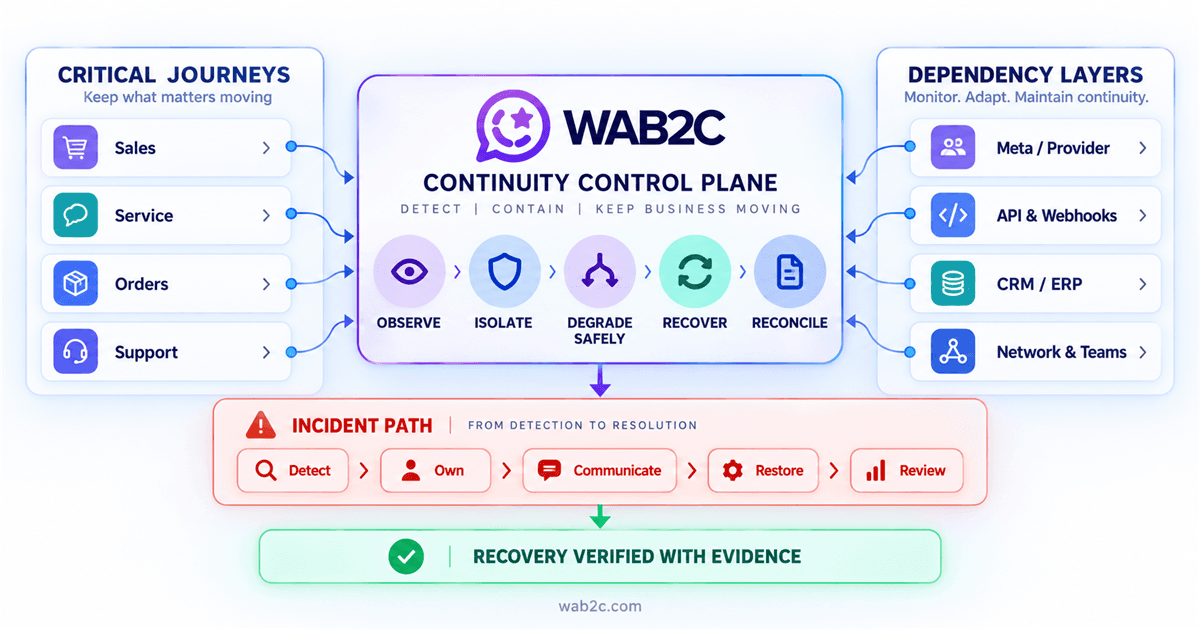
WAB2C Enterprise continuity connects detection, business impact, safe degradation, accountable escalation, controlled recovery and reconciliation across the full conversation chain.
External dependencies stay visible
Safe degradation is pre-decided
Retries do not replace reconciliation
Recovery requires business evidence
Continuity control plane
The visual separates customer journeys, controlled decisions, external dependencies and the recovery evidence needed before normal operation resumes.
Continuity playbook studio
Each dependency needs its own detection signals, business impact, safe operating mode, accountable escalation and recovery proof.
Timeouts, signature failures, event lag or retry growth
Accept safely where possible, preserve event identity and route exceptions to a controlled queue.
Idempotency preserved
Replay boundary approved
Source and target records reconcile
Dependency & recovery ledger
The ledger turns technical availability into the business decisions, ownership and evidence that determine whether a journey is truly restored.
Restore the service. Then restore trust in the work.
A dependency can recover while duplicates, stale promises and held transactions remain. Closure needs reconciliation, not optimism.
Control 01
Rank customer journeys by business impact and define the minimum service that must remain safe.
Control 02
Name the controlled, customer-managed and external layers so escalation goes to the correct owner.
Control 03
Connect technical alerts with business symptoms, queue age and customer-facing impact.
Control 04
Pre-approve what may continue, pause, queue, transfer or require human decision.
Control 05
Define restoration priority and tolerable data or processing delay for each critical journey.
Control 06
Prove retries, duplicates, pending work and system-of-record outcomes after recovery.
Continuity exposure & recovery workload model
This model does not predict outages or promise recovery. It translates stated assumptions into exposed work, safe deferral, manual handling, retries, reconciliation and sampled validation.
Current continuity reference frameworks
These official references inform readiness, continuity, incident and service-management discussions. They do not imply WAB2C certification, customer certification or implementation of every requirement.
ISO/IEC 27031:2025
Frames readiness of information and communication technology needed to support business continuity objectives.
ISO 22301:2019
Provides requirements for planning, operating, monitoring and continually improving continuity capability.
NIST SP 800-61 Rev. 3
Integrates incident response into cybersecurity risk management and connects preparation, response and improvement.
ISO/IEC 20000-1:2018
Provides requirements for establishing, delivering and improving managed services across their lifecycle.
Continuity readiness checklist
Complete the checks, then send the result to yourself or ask WAB2C to guide the unresolved dependency, fallback and recovery decisions.
0 / 7
controls confirmed
External interruptions could leave status messages, queued events and operational teams in different states.
The journey mapped dependencies, approved safe modes, owner escalations, replay controls and reconciliation evidence.
Teams could preserve customer intent, avoid blind replay and close incidents only after business outcomes matched authoritative systems.
Enterprise customer perspective
“WAB2C helped our teams separate platform, provider and business-system dependencies. Their support gave every disruption a clearer owner, fallback path and recovery check.”
Sumair Ahmed
CIO · EV Company
“The continuity design made escalation practical. WAB2C support helped us define safe degraded operations, reconcile pending work and preserve accountability when external services changed.”
Syed Abubakar
Head of IT · Accounting & Taxation Company
“We gained a much clearer operating response for queues, retries and system interruptions. The WAB2C team stayed involved through recovery validation and process improvement.”
Bilal Saeed
CTO · Mobile Phone Repair Company
The reason to meet
A focused 1:1 session can identify the minimum safe service, dependency owners, detection signals, queue and retry behaviour, recovery objective, escalation path and reconciliation evidence for one representative journey.
Decision FAQs
The answers reveal whether the enterprise has a recoverable operating model—or only technical uptime observations without safe customer and business decisions.
No. Meta, BSP, carrier, recipient device, network and customer-system conditions are external dependencies. A credible SLA defines the controlled scope, targets, evidence, exclusions and escalation path rather than promising an uncontrollable delivery outcome.
Review continuity referencesIt is a pre-agreed way to continue only the work that remains safe when a dependency is unavailable. It defines which actions continue, pause, queue, transfer or require human approval, and what customers should be told.
Inspect dependency playsReplay should preserve event identity, ordering needs, idempotency, policy and the authoritative state of connected systems. Unsafe items should be quarantined and reconciled instead of released blindly.
Review recovery evidenceNo. Recovery time and data-loss or processing-delay tolerance should reflect business impact, customer promise, legal and contractual needs, system capability and the minimum safe service for each journey.
Model continuity workloadThe enterprise still needs an internal incident owner who coordinates impact, customer communication, workaround, evidence and provider escalation. External responsibility does not remove internal accountability.
See owner boundariesA green status page alone is insufficient. Recovery evidence should show healthy signals, controlled queue release, successful retries, duplicate handling, authoritative system reconciliation, exception ownership and customer-impact closure.
Use the continuity checklistChat with our WAB2C experts
Get instant answers about WhatsApp API,
pricing, and features.
Available 24/7 • Response within 5 minutes