
Permitted
Open assigned conversation
Reply with approved content
Update permitted labels, status and notes
Identity, policy, change and evidence
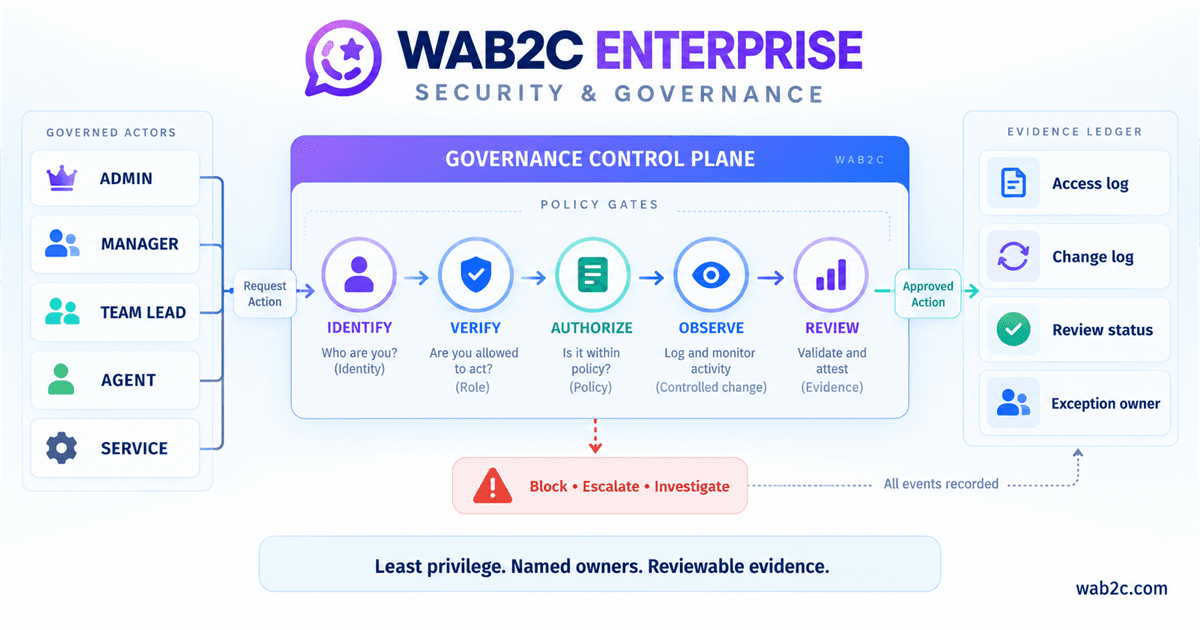
WAB2C Enterprise governance connects named identities, business roles, least-privilege policy, controlled change and operational evidence across human and machine work.
Named human and service identities
Least privilege by business mandate
Controlled production change
Exceptions remain owned and visible
The complete governance picture
The separate control-plane visual shows how a request becomes an approved action—or a blocked, escalated and investigated exception.
Role & decision matrix
Select an identity to see the actions it can perform, the decisions requiring approval, the prohibited shortcuts and the evidence leadership should expect.
Open assigned conversation
Reply with approved content
Update permitted labels, status and notes
Sensitive disclosure
Restricted template
Out-of-scope transfer or exception
View unrelated private queues
Change workspace, automation or integration policy
Governance control ledger
The control ledger helps business, IT, security and operations agree how responsibility is assigned and how material actions remain reviewable.
Access is not governed because it was granted correctly once.
People move, responsibilities change and exceptions expire. Governance maintains the relationship between identity, mandate and current need.
Control 01
Connect every role to business responsibility, data scope and permitted actions.
Control 02
Prevent one identity from requesting, approving and hiding the same material change.
Control 03
Require stronger review for access expansion, production policy and sensitive export.
Control 04
Record purpose, owner, test evidence, approval, release and rollback for material configuration.
Control 05
Keep actor, decision, before/after value, timestamp and outcome reviewable.
Control 06
Time-bound exceptions, name the risk owner and require closure or renewed approval.
Access and change governance workload model
This calculator models governance workload—not security maturity, compliance or risk reduction. Final control design depends on customer architecture, policies, contracts and risk decisions.
Current security reference frameworks
These official references inform governance, risk and control discussions. They do not imply WAB2C certification, customer compliance or implementation of every referenced control.
NIST CSF 2.0
Organises outcomes across Govern, Identify, Protect, Detect, Respond and Recover and elevates roles, policy and accountability.
ISO/IEC 27001:2022
Provides requirements for a risk-based information security management system and continual improvement.
ISO/IEC 27002:2022
Offers control guidance across organisational, people, physical and technological themes.
ISO/IEC 27005:2022
Guides identification, assessment, treatment, communication, monitoring and review of information security risk.
NIST SP 800-53 Rev. 5
A broad control reference including access control, audit, configuration, identity, incident and risk management families.
Governance readiness checklist
Complete the checks, then send the result to yourself or ask WAB2C to guide unresolved role, change and evidence decisions.
0 / 7
governance controls confirmed
Broad access and informal configuration changes made it difficult to explain who could act across teams and why an exception existed.
Named roles, privileged gates, controlled change and time-bound exceptions connected daily work to accountable approval paths.
Teams retained the speed required for service while leadership gained clearer access, change and exception evidence.
Enterprise customer perspective
“WAB2C helped us turn role discussions into practical operating controls. Their team support connected access, ownership, change approval and evidence without slowing daily customer service.”
Sumair Ahmed
CIO · EV Company
“The governance work was clear and grounded in responsibility. WAB2C support helped us separate administrative access, team oversight and operational actions while keeping exceptions visible.”
Syed Abubakar
Head of IT · Accounting & Taxation Company
“Our managers and teams gained clearer boundaries around customer conversations and configuration. The WAB2C team supported review, change control and escalation with strong technical ownership.”
Bilal Saeed
CTO · Mobile Phone Repair Company
The reason to meet
A 1:1 session can map the actor, business mandate, permitted scope, approval gate, prohibited shortcut, evidence, exception owner and review rhythm for one representative action.
Decision FAQs
The answers reveal whether the operating model can attribute, authorize and review sensitive work—or only exposes a collection of settings.
No. Applicable identity capabilities, provider dependencies and customer-side controls must be confirmed for the proposed scope. Governance begins by documenting the requirement and responsible boundary rather than implying unsupported availability.
Review the control referencesOnly approved roles whose mandate requires the action. High-impact changes should carry purpose, test evidence, approval, release record, rollback expectation and named production ownership.
Review controlled changeThe frequency should follow role sensitivity, privileged access, staff movement, contractual expectations and risk. Privileged and exceptional access normally deserves more frequent review than standard agent access.
Model the review workloadExpect a named actor or service identity, request and purpose, policy or role decision, approval where required, timestamp, before/after state, result and accountable exception owner.
See the evidence ledgerCustomer responsibilities can include identity lifecycle, endpoint and device controls, internal approvals, business-role design, workforce conduct, data classification and the security of customer-managed systems and credentials. Final responsibilities belong in the agreed architecture and contract.
Use the governance checklistChat with our WAB2C experts
Get instant answers about WhatsApp API,
pricing, and features.
Available 24/7 • Response within 5 minutes