
Read context
Current price, availability, customer, tax and delivery rules.
Systems that complete the work
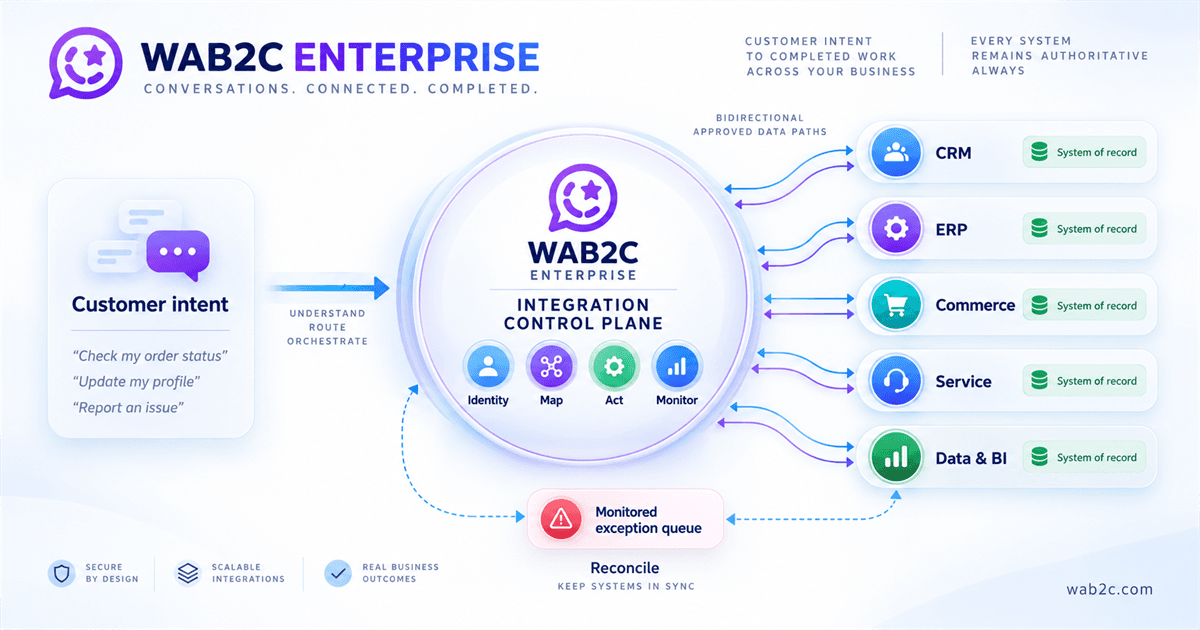
WAB2C connects WhatsApp journeys with CRM, ERP, commerce, service and data systems through explicit identity, authority, failure and reconciliation contracts.
Authoritative records stay authoritative
Identity is mapped before data moves
Failures remain owned and visible
Write-back is reconciled after recovery
The complete integration picture
This architecture belongs in its own section because it explains the operating boundary: WAB2C coordinates identity and work while each business system continues to own its records.
Integration architecture studio
Choose a business moment to inspect what triggers the integration, which system may be read or written, who owns failure and what proves completion.
Current price, availability, customer, tax and delivery rules.
Create or update the order through the approved service interface.
ERP or order platform owns the final order state.
Timeouts, validation failures and duplicate attempts stay visible.
Idempotency key, request result, order ID and final status.
Integration contract ledger
Enterprise reliability comes from the decisions around the interface: outcome, identity, authority, trust, exception ownership and reconciliation.
A successful response is not always a completed business outcome.
WAB2C designs the proof that the customer request reached the authoritative record and survived retry or recovery.
Decision 01
Define the work the integration must complete—not only the fields it can move.
Decision 02
Document the identifiers that link a number, customer, order, asset and case.
Decision 03
Name the authoritative system for every material state and write-back.
Decision 04
Keep credentials server-side and restrict each connection to its approved purpose.
Decision 05
Assign timeouts, invalid data, unavailable systems and access failures to named teams.
Decision 06
Prove source and destination agree after retries, delayed processing and recovery.
Integration handoff and reconciliation model
The model counts monitoring and exception effort instead of assuming every integrated transaction is free. It is a planning estimate, not a guaranteed saving.
International reference frameworks
These standards inform integration security, service, data governance and life-cycle discussions. They are references—not a claim that WAB2C or a deployment is certified.
ISO/IEC 27001:2022
A risk-based reference for access, credentials, data exchange and monitoring controls.
ISO/IEC 20000-1:2018
Supports ownership, service design, change, incident and continual-improvement discussions.
ISO/IEC 38505-1:2026
Guides governing bodies on effective, acceptable and accountable organizational use of data.
ISO/IEC/IEEE 12207:2026
Provides a current process reference for acquiring, building, operating and improving software-enabled integrations.
Readiness checklist
Complete the checks, then send the result to yourself or ask WAB2C to guide the unresolved integration architecture.
0 / 7
integration controls confirmed
Customer, vehicle, branch, job-card and parts context were re-entered while status lived in separate systems.
The journey matched identity, created the service request, linked the job reference and returned verified milestones.
Teams could answer from source-system truth while exceptions and reconciliation stayed owned by the right system team.
Enterprise customer perspective
“WAB2C helped our teams connect customer conversations with operational systems without confusing ownership. Their support stayed close to the integration decisions and made each handoff easier to govern.”
Sumair Ahmed
CIO · EV Company
“The integration approach was practical and transparent. WAB2C support helped us define authoritative records, exceptions and access responsibilities before technical work moved into the production environment.”
Syed Abubakar
Head of IT · Accounting & Taxation Company
“WAB2C connected customer context to service operations while keeping failed updates visible. Their technical team understood real exceptions, supported testing and did not treat integration as a one-time connector.”
Bilal Saeed
CTO · Mobile Phone Repair Company
The reason to meet
A 1:1 session can define the business trigger, identity, source of truth, read and write scope, trust boundary, idempotency, exception owner, reconciliation and acceptance evidence for one representative journey.
Decision FAQs
The answers reveal whether the proposal is only a connector—or an owned, secure and reconcilable enterprise operating design.
A connector provides a technical path. An enterprise integration also defines identity, systems of record, permitted data, business outcome, failure ownership, reconciliation, support and change control around that path.
Review the integration contractAuthority should be assigned field by field and outcome by outcome. CRM may own customer identity, ERP may own the order, and a service platform may own resolution. WAB2C coordinates the journey without silently replacing those records.
Explore operating patternsThe design should stop unsafe write-backs, preserve the request, expose the failing dependency, retry only where safe, route the exception to a named owner and reconcile once service recovers.
See failure ownershipNo. Some outcomes can use supported connectors, workflow tools or configuration. Others need customer or partner development through APIs and webhooks. The correct pattern follows the outcome, volume, risk and support model.
Explore APIs and webhooksUse server-side secrets, least-privilege permissions, encrypted transport, approved data minimisation, controlled rotation, monitoring and documented customer-versus-provider responsibilities for every trust boundary.
Review the reference frameworksModel manual touches, handling time, correction effort, coverage, exceptions, monitoring and reconciliation together. The net capacity model below keeps the assumptions visible and avoids presenting gross automation as guaranteed savings.
Use the integration modelChat with our WAB2C experts
Get instant answers about WhatsApp API,
pricing, and features.
Available 24/7 • Response within 5 minutes