
Named access
Eligible contacts, channels and escalation routes are documented before the issue.
Named paths, evidence and escalation
WAB2C Dedicated Enterprise Support creates a documented route from business impact to severity, responsible owner, dependency coordination, update cadence and verified closure—within the scope agreed for your enterprise.
Named customer and WAB2C service owners
Business-impact severity instead of inbox priority
Provider and customer dependencies remain visible
Service reviews convert repeated issues into improvement
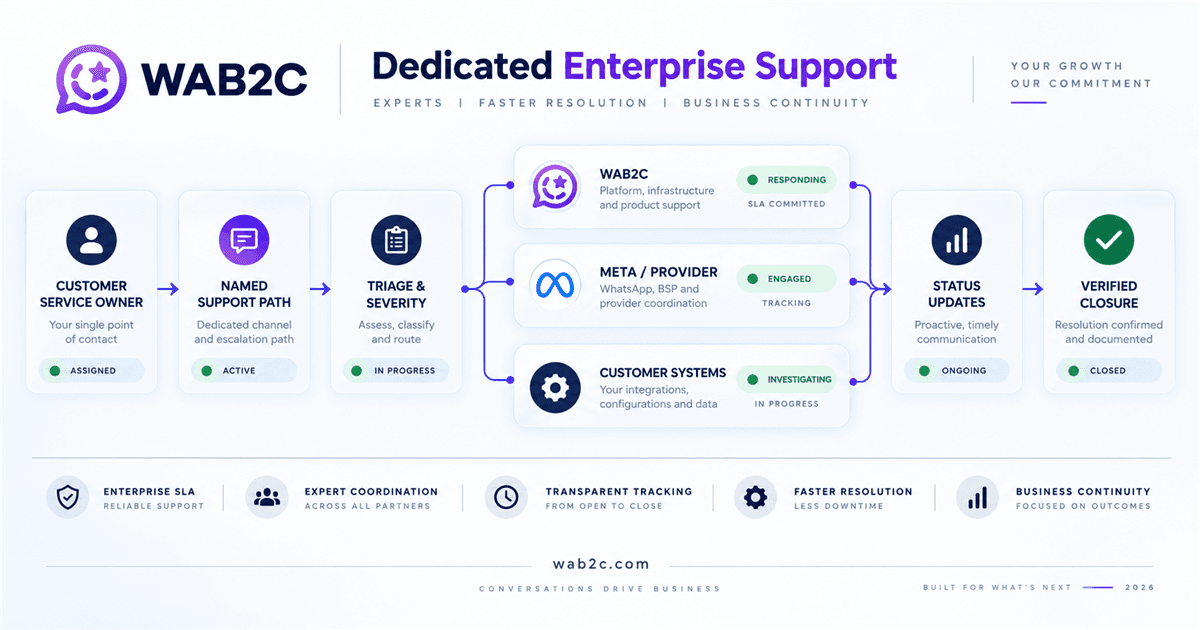
Support coordination map
The operating picture separates WAB2C scope, Meta or provider dependency and customer-controlled systems while preserving one coordinated status path.
Support decision desk
Explore the questions, owner and evidence expected at each support decision. Severity is not a label; it changes coverage, coordination and communication.
Evidence that should remain
Impact statement and timestamps
Affected journey and scope
Workaround and dependency status
Decision risk
Calling every urgent request P1 erodes the route when a real critical interruption occurs.
Operating principles
The page turns a sales claim into observable responsibilities, evidence and decision boundaries.
Eligible contacts, channels and escalation routes are documented before the issue.
Impact, scope, timestamps and reproduction evidence determine the path.
WAB2C, Meta, providers and customer systems retain clear responsibility boundaries.
Recovery, confirmation, root learning and improvement actions complete the record.
Support coverage & escalation workload
Translate monthly case demand, severity, evidence quality and first-line containment into a visible coordination workload before coverage is contracted.
Current reference frameworks
These official sources provide management, service, quality, continuity, procurement or evidence context relevant to this page. Applicability, scope and conformance must be verified for the actual enterprise and agreement.
ISO/IEC 20000-1:2018
A reference for planning, operating, measuring and improving managed services with accountable ownership.
ISO/IEC 20000-2:2019
Provides guidance and examples for interpreting and applying an ISO/IEC 20000-1 service-management system.
ISO 22301:2019
A continuity reference for critical service dependencies, disruption response and recovery planning.
NIST SP 800-61 Rev. 3
Current NIST guidance for integrating incident-response considerations across cybersecurity risk management.
Dedicated Support readiness checklist
Complete the seven checks, send the result to yourself or ask WAB2C to guide unresolved operating, evidence and commercial decisions.
0 / 7
controls confirmed
A failed service-booking journey could cross WAB2C, Meta, an integration and a customer system, creating parallel investigations and conflicting updates.
A named service owner classified impact, preserved one incident record, coordinated each dependency and issued customer-safe updates on a defined cadence.
Leadership gained one accountable view of impact, ownership, evidence, recovery and recurring improvement without pretending every dependency sat inside WAB2C control.
Enterprise customer perspective
“WAB2C gave our teams a clear operating path and dependable support. Their team stayed engaged, translated issues into actions and kept ownership visible through closure.”
Sumair Ahmed
CIO · EV Company
“The team support is practical and accountable. Scope, evidence and next decisions remain visible, which makes internal coordination and management review much easier.”
Syed Abubakar
Head of IT · Accounting & Taxation Company
“WAB2C supports the complete operating model, not only the interface. Their team helped us connect technical decisions with service ownership and measurable business outcomes.”
Bilal Saeed
CTO · Mobile Phone Repair Company
The reason to meet
A focused 1:1 session can map the business impact, eligible route, dependency boundary, escalation owner, communication cadence, closure evidence and service-review decision for one real operating scenario.
Decision FAQs
The answers are structured for human buyers, voice queries and search systems—then linked back to the exact operating model, calculator or evidence section that provides more detail.
Coverage is defined in the executed enterprise agreement. A responsible scope identifies eligible services, environments, contacts, hours, request channels, severity rules, escalation and customer responsibilities instead of implying unlimited support.
Review the service frameworkThe agreed framework should tie severity to verified business impact, affected capability, scope and workaround. The customer reports impact; WAB2C validates classification through the documented support path.
Open the severity deskNo. WAB2C can collect evidence, identify likely dependency, coordinate the provider route and communicate status within scope, but Meta and external providers control their systems, policies and recovery decisions.
See dependency coordinationCoverage depends on the contracted service window and severity path. Business-hours support, urgent escalation and optional extended coverage must be described in the agreement rather than inferred from a website badge.
Model coverage demandClosure should record the recovered state, customer confirmation where appropriate, responsible dependency, evidence, workaround or correction, unresolved risk and follow-up action. Technical recovery alone may not complete the business record.
Use the readiness checklistA service review should identify recurrence, impact, ownership, known problem or dependency, improvement action, target date and evidence of change. Trends should inform priority instead of remaining separate tickets.
Review the customer perspectiveChat with our WAB2C experts
Get instant answers about WhatsApp API,
pricing, and features.
Available 24/7 • Response within 5 minutes