
31%
Delivery change
share of demand
Communication intelligence
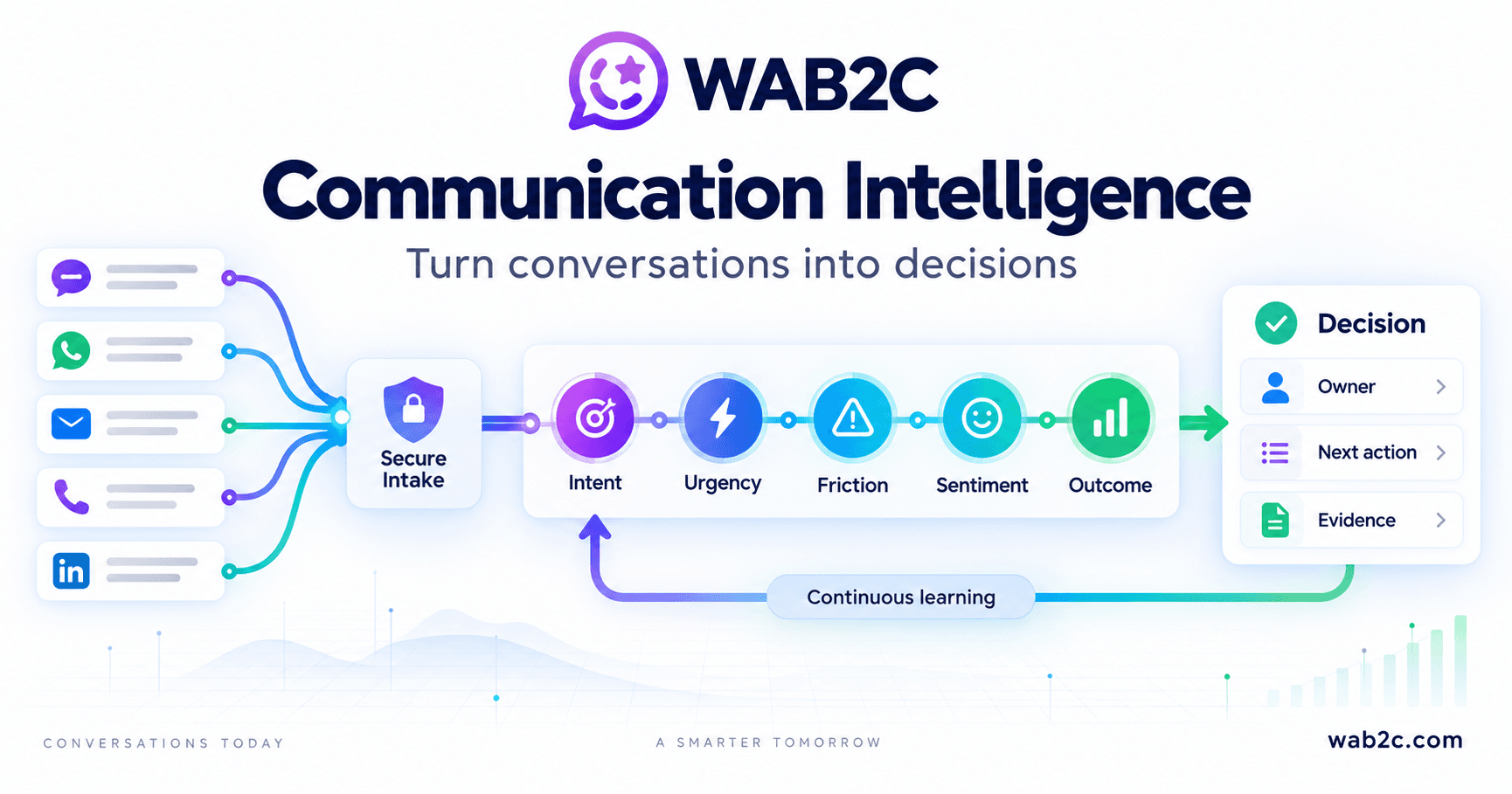
Structure demand, intent, urgency, friction and outcomes—then connect each material signal to an owner, next action and inspectable evidence.
Original context stays visible
Unknowns remain reviewable
AI confidence matches decision risk
Every insight ends with an owner
Decision intelligence workbench
Conversation signal · context · accountable action
Incoming evidence
Where is my delivery?
Order status
I already sent payment
Payment proof
Please change my address
Delivery change
Intent
Delivery change
Urgency
Before dispatch
Friction
Repeat contact
Confidence
82%
Decision brief
Review address-change ownership before dispatch.
OwnerOperations
ReviewToday
Signal workbench
Switch lenses to see how the same conversation estate supports different operating decisions.
31%
Delivery change
share of demand
22%
Payment help
share of demand
18:00
Peak window
local time
+14%
New demand
period change
Recommended action
Review evening coverage and redesign the top two intents.
Accountable owner: Customer operations
Intelligence taxonomy
A practical taxonomy protects context, limits label sprawl and connects each field to an owner and business purpose.
Keep “unknown” visible. Forced classification creates false certainty and hides where definitions or models need improvement.
Intent
Change delivery address
Route work and group comparable demand
Journey design
Urgency
Before dispatch
Prioritise time-sensitive action
Operations
Friction
Second contact
Locate avoidable effort and process gaps
Service design
Outcome
Address updated
Separate conversation closure from business completion
Business owner
Evidence
Order event + reviewed sample
Make the interpretation inspectable
Data governance
Language context
Preserve original and translated meaning.
Confidence
Show certainty and review threshold.
Source evidence
Retain the event or sample behind a claim.
Closed-loop intelligence
The operating loop combines structured evidence with human judgement, then measures whether the action changed the original pattern.
Collect approved conversation and workflow signals with purpose and access controls.
Apply stable fields, taxonomies, statuses and events around real decisions.
Combine patterns with context, confidence, exceptions and human review.
Rank by materiality, recurrence, risk and the ability to act.
Assign an owner, next action, evidence requirement and review date.
Track whether the decision changed the original pattern or outcome.
Decision
Intent volume by hour
Queue and transfer pattern
Resolution and repeat contact
Action
Test extended ownership coverage for the two highest-demand evening intents.
Measure
Repeat-contact and time-to-owned-action change
Review
Weekly service review
Intelligence governance
These standards provide useful quality, complaints, security and AI-management references. They do not imply WAB2C or customer certification.
Supports consistent definitions, process ownership, corrective action and continual improvement.
Evidence to validate
Definition owner · decision record · corrective action
Provides useful guidance for receiving, analysing and improving from customer complaints.
Evidence to validate
Complaint category · resolution path · improvement loop
Guides purpose-based access, secure processing, export control and risk ownership for conversation evidence.
Evidence to validate
Purpose · access · retention · activity record
Provides a reference for accountable AI roles, impact assessment, monitoring and continual improvement.
Evidence to validate
AI purpose · human oversight · performance review
Intelligence coverage and value model
Model intelligence coverage, analysis capacity and potentially avoidable repeat contact. Each assumption includes an example and every result exposes its formula.
Monthly conversations
Eligible conversations in the selected intelligence scope.
Example: 30,000 may cover customer support, order, payment and service demand.
Current reviewed sample
Share currently visible through manual review, QA sampling or ad-hoc analysis.
Example: 5% means only 1,500 of 30,000 conversations are routinely examined.
Target structured coverage
Share expected to receive usable structured signals after implementation.
Example: 70% excludes unsupported, low-confidence or out-of-scope conversations.
Weekly analysis hours
Current human time spent sampling, classifying, reconciling and presenting conversation evidence.
Example: 28 hours may be distributed across QA, operations and analytics staff.
Loaded hourly cost
Planning cost per analysis hour including salary and employment overhead.
Example: PKR 3,200 is a modelling assumption—not a WAB2C price.
Analysis automation coverage
Share of current preparation effort that structured signals may remove or standardise.
Example: 55% still leaves judgement, investigation and decisions with people.
Repeat-contact rate
Share of conversations that represent another contact about the same unresolved need.
Example: 18% of 30,000 conversations equals 5,400 repeat contacts.
Preventable repeat share
Portion of repeat contacts linked to addressable information, ownership or process gaps.
Example: 35% avoids assuming every repeated contact can be prevented.
Improvement capture
Share of preventable repeats expected to be avoided after an evidence-led change.
Example: 40% recognises adoption and external constraints.
Value per avoided repeat
Planning cost or value assigned to one repeat contact avoided.
Example: PKR 1,800 may include handling effort and service-recovery cost.
Planning indication
Combined planning value from analysis capacity reclaimed and repeat contacts potentially avoided.
1,500
currently visible
21,000
structured coverage
19,500
visibility gain
67h
analysis hours reclaimed
756
repeats potentially avoided
PKR 1,360,800
repeat-contact value
This is a planning estimate—not a guaranteed saving or outcome. Validate sampling, classification quality, coverage, preventability, attribution and commercial value before approval.
Intelligence readiness
Complete the checklist, then send the result to yourself or ask WAB2C to guide the readiness review.
0 / 8
0 of 8 communication-intelligence readiness controls complete.
Repeat delivery-change messages rose in one region, one time window and one partner workflow.
Operations reviewed examples, assigned an owner and changed the pre-dispatch evidence and handoff rule.
The next review compared repeat contact, successful update and downstream delivery outcome against the baseline.
Enterprise customer perspective
“WAB2C helped our teams see the reasons behind customer demand instead of only counting messages. Their support connected operational questions, reporting logic, and practical action throughout implementation.”
Sumair Ahmed
CIO · EV Company
“The communication structure improved how management reviews client needs and recurring friction. WAB2C explained classifications clearly, supported governance decisions, and remained responsive while teams refined the operating model.”
Syed Abubakar
Head of IT · Accounting & Taxation Company
“WAB2C made conversation patterns easier to turn into ownership and follow-up. Their team supported the technical setup closely and helped us keep evidence connected to operational decisions.”
Bilal Saeed
CTO · Mobile Phone Repair Company
The reason to meet
A 1:1 consultation can frame the management question, taxonomy, evidence source, review threshold, accountable owner and first improvement measure worth implementing.
Decision FAQs
Clear answers help leaders distinguish inspectable decision intelligence from another activity dashboard or ungoverned AI classification layer.
Chat analytics often reports activity such as message or response volume. Communication intelligence structures demand, intent, urgency, friction and outcomes, then connects a material pattern to an interpretation, accountable owner, decision and improvement measure.
Explore the intelligence lensesBegin with decisions and workflows, not every phrase customers use. Define a controlled top-level taxonomy, preserve examples and unknowns, assign an owner, and add detail only when it changes routing, service, product or risk action.
Review the taxonomy studioAI can assist classification and pattern detection, but automation should reflect confidence and impact. Low-confidence, sensitive or high-impact decisions require defined human review, exception handling and retained evidence.
See the decision loopA solution can preserve original language and use approved translation or speech services to support analysis. The enterprise should validate accuracy, purpose, provider handling, confidence and human review for the intended languages and decisions.
Review context requirementsModel current visibility, analyst effort, repeat-contact rate, preventable share and realistic improvement capture. Keep capacity and outcome value separate, show every formula and validate attribution before treating the result as a business case.
Use the intelligence value modelDefine an approved purpose, minimum necessary fields, role-based access, retention, exports, provider handling, human oversight and a record of material decisions. Sensitive conversation access should never be implied by platform availability alone.
Review governance alignmentChat with our WAB2C experts
Get instant answers about WhatsApp API,
pricing, and features.
Available 24/7 • Response within 5 minutes