
Decisions at this gate
Which scenarios represent real operating risk?
Who can accept, reject or waive a defect?
Are users, support and cutover genuinely ready?
Discovery through controlled adoption
WAB2C Enterprise onboarding turns requirements into an owned operating model, proven solution, prepared workforce and controlled production wave with visible go, hold and improvement decisions.
Scope and exclusions stay visible
Decision rights precede configuration
UAT proves real operating scenarios
Launch is a controlled business decision
Controlled launch program
The standalone visual connects business outcomes, five evidence gates, accountable owners and the go or hold decision that protects production adoption.
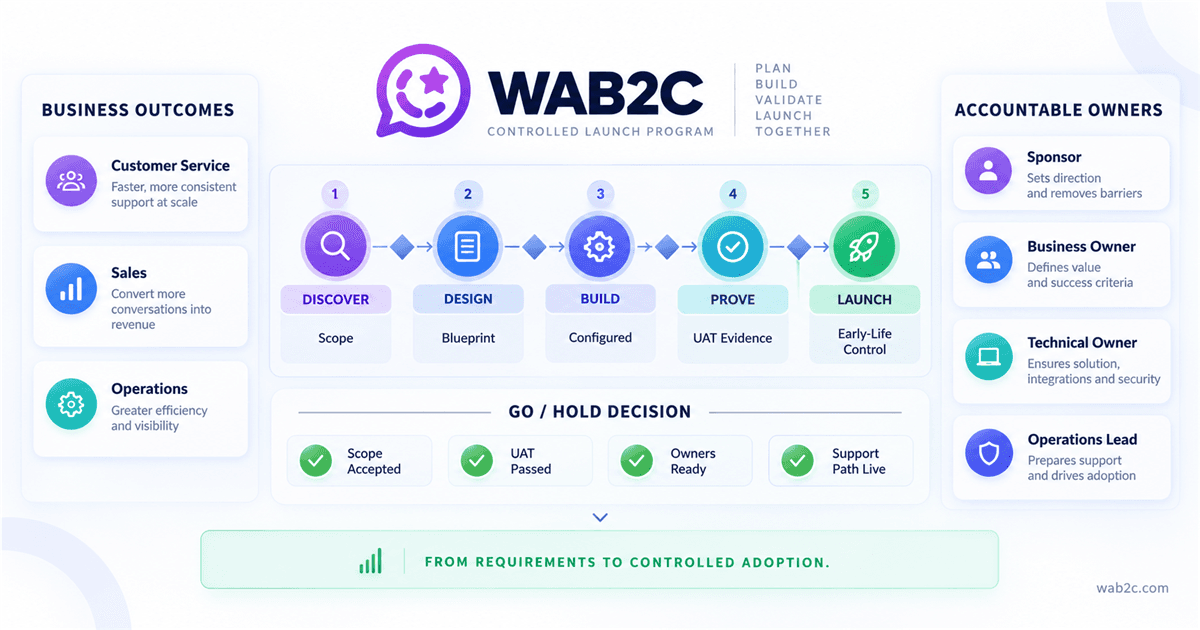
Delivery stage-gate cockpit
Each gate creates a business artifact and an accountable decision. Progress is not measured by activity alone.
Which scenarios represent real operating risk?
Who can accept, reject or waive a defect?
Are users, support and cutover genuinely ready?
Scenario-level UAT results
Defect and waiver decisions
Training, support and cutover readiness
Counting a login or happy-path demo as evidence that the enterprise can operate the journey.
WAB2C supports scenario design, defect triage, readiness review and go/hold evidence.
Implementation control ledger
The ledger keeps scope, architecture, acceptance, people and early-life operation aligned while the solution changes from plan to production.
Onboarding is complete when the enterprise can operate—not when credentials arrive.
The strongest launch evidence shows how real users handle expected, exceptional and failed journeys with working support and ownership.
Control 01
Connect business outcome, wave scope, exclusions, success measures, constraints and executive sponsorship.
Control 02
Name who decides scope, design, security, data, acceptance, waiver, launch and rollback.
Control 03
Document systems, identifiers, dependencies, authority, privacy and production trust boundaries.
Control 04
Test expected, exception, failure, permission, performance and recovery scenarios against explicit criteria.
Control 05
Prepare administrators, managers, agents, support contacts, knowledge and escalation before go-live.
Control 06
Control cohort, timing, telemetry, go/hold thresholds, hypercare and the next expansion decision.
Implementation readiness & launch exposure model
This model supports a readiness conversation; it cannot replace acceptance, security, legal or executive authority. A higher score does not override critical defects or an accountable hold decision.
Current implementation reference frameworks
These official references inform project, quality, service-management and continuity discussions. They do not prescribe one universal method, certify this page or replace scope-specific customer governance.
ISO 21502:2020
Provides guidance on project-management concepts and practices that can be adapted to enterprise implementation governance.
ISO/IEC 25010:2023
Provides a product-quality model that can inform non-functional requirements and acceptance criteria for technology solutions.
ISO/IEC 20000-1:2018
Provides requirements for planning, transition, delivery, assurance and improvement of managed services.
ISO 22301:2019
Provides a continuity-management reference for launch dependencies, recovery planning and controlled operating readiness.
Implementation readiness checklist
Complete the checks, then send the result to yourself or ask WAB2C to guide unresolved scope, acceptance, workforce and early-life decisions.
0 / 7
controls confirmed
Multiple regions, roles and integrations created different readiness levels and competing expectations for launch.
The program used stage gates, scenario UAT, named acceptance, role-based training and a defined go/hold path.
The first wave produced real production evidence, support learning and adoption data before broader rollout decisions.
Enterprise customer perspective
“WAB2C brought business, operations and technology into one controlled launch plan. Their team support made ownership, UAT and early-life decisions clear across our regions.”
Sumair Ahmed
CIO · EV Company
“The onboarding process was structured around decisions and evidence, not only configuration. WAB2C support helped our stakeholders understand acceptance, responsibilities and the production support path.”
Syed Abubakar
Head of IT · Accounting & Taxation Company
“We moved through design, integration and launch with visible gates. The WAB2C team supported defect triage, user readiness and a controlled first production wave.”
Bilal Saeed
CTO · Mobile Phone Repair Company
The reason to meet
A focused 1:1 session can outline the wave scope, stakeholders, architecture, acceptance scenarios, readiness evidence, go/hold authority, support path and first decisions required to turn one priority journey into a controlled launch program.
Decision FAQs
The answers reveal whether the enterprise is preparing a controlled operating capability—or simply configuring software and hoping users, systems and support align later.
There is no responsible universal duration. Timing depends on journey scope, decision speed, provider readiness, integrations, security and data review, configuration, UAT, user readiness and defect closure. WAB2C establishes scope-specific milestones and dependencies.
Review the stage gatesMost enterprise launches need an executive sponsor, business owner, operations lead, technical owner, administrators and acceptance owners, with security, privacy, data, procurement or legal participation where the scope requires it.
Review decision ownershipMeaningful UAT covers real business scenarios, expected and exception paths, failure and recovery, permission boundaries, integrations, reporting and responsible users. It records criteria, evidence, defects, waivers and an accountable acceptance decision.
Inspect the Prove gateThe agreed customer decision authority should make the business launch decision using evidence from WAB2C and all relevant owners. WAB2C supports readiness analysis but does not silently replace customer risk, acceptance or executive authority.
Model launch readinessThe change should be described, impact-assessed and approved through the program's decision path. Schedule, dependencies, acceptance, commercial scope and launch evidence should be updated instead of hiding change inside configuration activity.
Use the launch checklistEarly-life operation should monitor customer impact, queues, delivery, integration, defects, adoption and support. Named owners decide fixes, rollback or expansion, and the next wave should begin only with reviewed evidence from the first.
See the phased launch patternChat with our WAB2C experts
Get instant answers about WhatsApp API,
pricing, and features.
Available 24/7 • Response within 5 minutes