
Receive demand
One official entry point
Chat with our WAB2C experts
Get instant answers about WhatsApp API,
pricing, and features.
Available 24/7 • Response within 5 minutes
The enterprise operating layer
Unify WhatsApp context, people and business actions in one operating layer—without turning every request into the same queue.
Context before response
Ownership through handoff
Continuity across shifts
Evidence for improvement
Enterprise Service
Official WhatsApp operating layer
The item in order PK-10428 arrived damaged. Can you help?
10:24
I found your order and delivery history. I've opened a replacement request with the service team.
10:24
Conversation work item
In progressCustomer: Identity confirmed
Journey: Replacement
Owner: Service desk
Next action: Approve dispatch
See the operating logic
The conversation should explain the work behind it. Each step adds context, accountability or evidence leaders can inspect.
One official entry point
Identity + intent + history
Team + system actions
Resolution + next step
Reason + learning
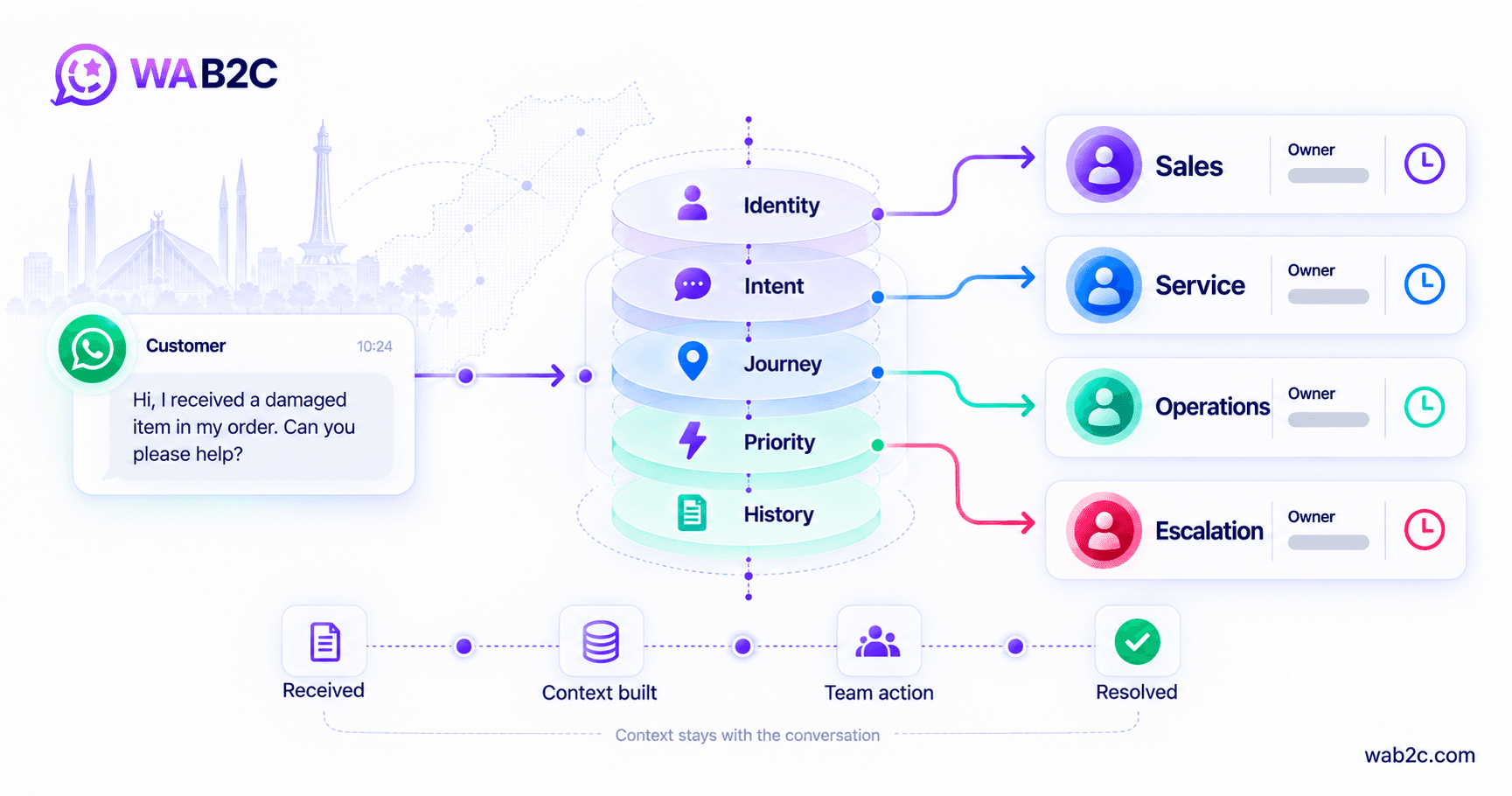
One conversation. One connected operating record.
Identity, intent, journey and history stay with the work as teams coordinate action and retain resolution evidence.
Context → collaboration → action → evidence
Three-layer operating model
Each layer adds the context, action and control needed to explain what the customer needs, who is acting and whether the outcome is complete.
Identity, intent, journey and history arrive in one governed record so the customer is not forced to reconstruct the request at every touchpoint.
Context stays connected
Named owners, internal notes, approvals, handoffs and supported system actions coordinate the work behind the customer response.
People and actions aligned
Response, pending time, resolution reason, repeat contact, SLA risk and exceptions remain observable so leaders can improve the operation.
Outcome evidence retained
Organize incoming demand by function, urgency, customer context and business hours.
Operating controlKeep the responsible team and agent visible from first response through closure.
Operating controlTurn a message into a qualified, routed and trackable unit of work.
Operating controlConnect conversation activity with response, backlog and outcome reporting.
Operating controlConversation command view
Context, work and outcome snapshot
1,284
Conversations
94%
With next action
21
Awaiting action
PK-10428
Damaged order
Replacement approved
ResolvedPK-10431
Plan upgrade
Proposal requested
ActionPK-10436
Payment dispute
Finance review
At riskPK-10442
Service visit
Appointment booked
ResolvedFields, work states, roles and connected systems are confirmed during enterprise solution design.
Control and standards alignment
ISO/IEC 27001:2022
Use role-based access, controlled change and traceable conversation handling as security-management evidence.
Evidence to validate
Access matrix · change record · activity evidence
ISO 22301:2019
Define continuity ownership, alternative operating paths and recovery evidence before a critical journey is activated.
Evidence to validate
Continuity test · recovery owner · operating runbook
ISO/IEC 20000-1:2018
Connect requests, incidents, service ownership and continual improvement to the conversation operating model.
Evidence to validate
Service owner · work states · review cadence
ISO 10002:2018
Design accessible complaint capture, accountable handling, progress visibility, resolution and improvement evidence.
Evidence to validate
Complaint owner · status path · closure reason
Named service owner
Context retention rule
Auditable work states
Measured resolution evidence
Conversation operations outcome calculator
Set the operating assumptions, then use the result as a discovery input—not a guaranteed performance claim.
Your operating assumptions
Tap +/−, type a number or use the slider.
Monthly conversations
Every customer conversation entering the operating model during one month.
Example: 25,000 conversations can include sales, service, delivery, payment and support journeys.
Current repeat-contact rate
The share of conversations where the customer must contact again because context, action or resolution was incomplete.
Example: 22% means 22 of every 100 conversations currently lead to another contact about the same need.
Target repeat-contact rate
The share expected to still require another customer contact after the improved operating model is in place.
Example: 10% means the plan allows for 10 of every 100 conversations to require another contact.
Minutes per repeat contact
Average team time needed to reopen the request, reconstruct context, coordinate action and respond again.
Example: 6 minutes represents the complete additional handling effort created by one repeat contact.
Estimated monthly operating effect
3,000
repeat contacts avoided
300
team hours recovered
22,500
without repeat contact
Formula and calculation transparency
1. Avoidable rate gap
Current repeat-contact rate − target repeat-contact rate
22% − 10% = 12%
2. Repeat contacts avoided
Monthly conversations × avoidable rate gap
25,000 × 12% = 3,000
3. Team hours recovered
Repeat contacts avoided × minutes per repeat contact ÷ 60
3,000 × 6 ÷ 60 = 300 hours
4. Conversations without repeat contact
Monthly conversations × (100% − target repeat-contact rate)
25,000 × 90% = 22,500
Results are rounded to the nearest whole conversation or team hour. The model does not apply financial value, staffing cost or revenue assumptions.
Standards that matter
Customer context is retained
Next action is explicitly owned
Pending work has a reason
Resolution evidence stays auditable
The result only reflects the assumptions above. Actual outcomes depend on demand, team behavior, integrations, policy, operating hours and implementation quality.
Enterprise readiness checklist
Check what is already true today. The remaining items become a practical discovery agenda.
Readiness progress
0%
0/8 conversation operations readiness checks complete (0%).
Affirmative Use Case · National retail operation
Order questions, damaged items, refunds and store support share one operating record while the right commercial, service and operations teams complete their part.
Internally, a single message may require order history, store operations, finance approval and a customer-facing resolution.
Identity, order, history, priority and promised next action remain visible while different teams complete their responsibility.
Pending age, ownership, repeat contact, SLA risk and closure reason remain comparable by journey and team.
National conversation operating record
Identity + order + history + promised outcome
Order record
Connected to Commerce system
Visible next actionDamage evidence
Connected to Service review
Visible next actionReplacement approval
Connected to Operations action
Visible next actionCustomer resolution
Connected to Service owner
Visible next actionThe customer receives one coherent answer while internal teams keep accountable actions and evidence.
Customer reviews
Approved feedback from leaders using WAB2C across customer operations, professional services and technical support.
“WAB2C helped our customer operations move faster across sales and service. The team understood our requirements, supported implementation closely, and remained responsive whenever our automotive workflows needed refinement at scale.”
Sumair Ahmed
CIO · EV Company
“WAB2C gave our accounting and taxation teams a clearer way to manage client conversations. Their support team guided setup carefully, answered technical questions promptly, and helped improve internal ownership controls.”
Syed Abubakar
Head of IT · Accounting & Taxation Company
“WAB2C brought structure to our repair enquiries and customer follow-ups. The implementation team remained accessible, resolved configuration questions quickly, and helped our technical staff manage conversations with confidence every day.”
Bilal Saeed
CTO · Mobile Phone Repair Company
Enterprise guardrails
Roles and responsibilities are defined before launch
External Meta and provider dependencies remain visible
Operating definitions are agreed before dashboards are accepted
Meta approvals, messaging policy, provider infrastructure and external systems remain dependencies unless explicitly included in the written scope.
The reason to meet
Bring your customer journeys, teams, work states, service risks and connected systems. The discussion will identify the context model, collaboration path, control points and measures that need validation.
Priority journeys and required context
Team actions, roles and handoff model
Pending, escalation and closure rules
Integration questions and evidence plan
Decision FAQs
Short, direct answers for leadership, technology, operations and procurement teams evaluating WhatsApp as an enterprise operating layer.
It is the governed layer between a customer message and the work needed to complete the request. WAB2C connects identity, intent, history, ownership, team collaboration, supported system actions and measurable resolution so WhatsApp becomes an operating channel rather than an isolated inbox.
See the three-layer operating modelThe operating design keeps agreed customer, journey, ownership, notes and action context connected to the conversation. Handoff rules define what must travel with the work, who accepts responsibility and what happens if the receiving team is unavailable.
Review the continuity use caseYes, where the required source and integration are supported. WAB2C can surface approved context and trigger supported actions while source-of-truth rules, authentication, reconciliation, data ownership, failure handling and fallback behavior are confirmed before implementation.
Explore CRM, ERP and data architectureLeaders should compare demand, ownership, first response, pending age, repeat contact, transfer volume, resolution reason, reopen rate and completed business outcomes by journey and team. WAB2C keeps definitions and assumptions explicit so improvement can be validated against an agreed baseline.
Model the operating outcomeThe control design can map to relevant practices from ISO/IEC 27001:2022, ISO 22301:2019, ISO/IEC 20000-1:2018 and ISO 10002:2018. These are reference frameworks, not a claim of certification; applicable scope, controls and evidence must be confirmed during procurement.
Review standards and evidence mappingProcurement should confirm journeys, ownership definitions, access roles, conversation and data boundaries, integration dependencies, retention, audit evidence, continuity, onboarding, support, service levels, commercial assumptions and the written responsibility boundary between WAB2C, Meta, providers and customer systems.
Use the enterprise readiness checklist