
Approved read
Price, stock, payment state, order status and permitted fulfilment context.
Authoritative context, controlled movement
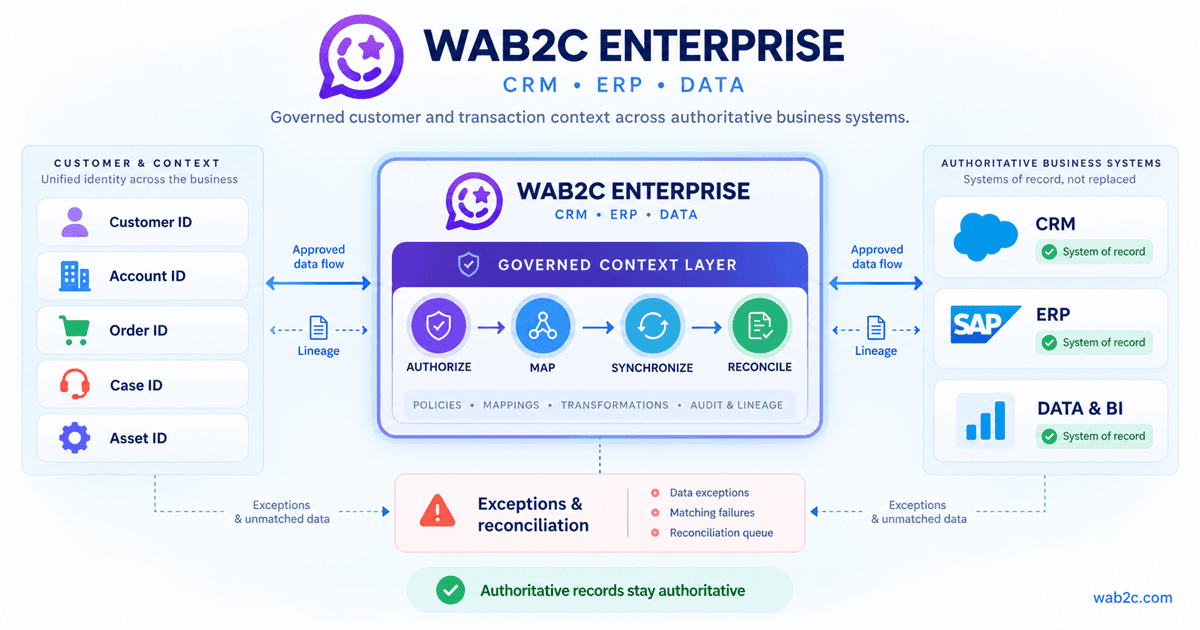
WAB2C connects customer intent with governed CRM, ERP, service and analytical context while the systems responsible for each record remain authoritative.
No silent record merge
One authority for every material state
Purpose-limited data movement
Visible quality and reconciliation
The complete data picture
The standalone architecture makes identity, approved movement, system authority, lineage and reconciliation visible before implementation begins.
Context contract studio
Select a context pattern to inspect what may be read, what may be written, who owns the state and how a conflict is handled.
Price, stock, payment state, order status and permitted fulfilment context.
Create an authorised order action or append approved customer evidence.
ERP or commerce platform owns transactional state and accounting records.
Time-sensitive state is queried close to the customer response.
Payment, stock or order-state mismatch blocks confirmation and is reconciled.
Idempotency key, order ID, response, source timestamp and final disposition.
Data authority & lineage ledger
This ledger turns a vague “system integration” into decisions that data, application, security and operations owners can review together.
One label can hide several incompatible meanings.
“Customer status” may describe sales stage, account standing, service eligibility or campaign consent. Govern the meaning before moving the value.
Data context and reconciliation workload model
This is a transparent planning model for data operations. It does not claim that every match, read or write-back will be correct without customer-specific architecture, rules and testing.
International reference frameworks
These current official references inform the operating discussion. They are not a claim that WAB2C or a customer deployment is certified.
ISO/IEC 38505-1:2026
Guides governing bodies on effective, efficient and acceptable organizational use and protection of data.
ISO 8000-61:2016
A current process reference for managing data quality and assessing process capability or maturity.
ISO/IEC 11179-1:2023
Supports shared understanding of data descriptions, concepts and relationships across people and systems.
ISO/IEC 27001:2022
Provides a risk-based management-system reference for protecting information across the data lifecycle.
Data readiness checklist
Complete the checks, then send the result to yourself or ask WAB2C to guide unresolved authority, quality and lineage decisions.
0 / 7
data governance controls confirmed
Customer and vehicle context lived across sales, warranty, service and regional operations, producing repeated lookup and inconsistent answers.
The journey resolved approved identifiers, read current authoritative context and returned source references with every operational action.
Teams could answer from shared truth while ambiguous identity, stale state and failed write-back remained visible for reconciliation.
Enterprise customer perspective
“WAB2C helped us preserve customer and vehicle context without weakening the authority of our operational systems. Their team support made identity, ownership and reconciliation decisions practical.”
Sumair Ahmed
CIO · EV Company
“The data approach was disciplined and understandable. WAB2C support helped our teams agree field ownership, access boundaries and evidence before connecting customer conversations to business records.”
Syed Abubakar
Head of IT · Accounting & Taxation Company
“Customer, device and repair context became easier to follow across systems. The WAB2C team stayed involved through mapping, exception testing and the final operating handoff.”
Bilal Saeed
CTO · Mobile Phone Repair Company
The reason to meet
A 1:1 session can map the identifiers, fields, systems of record, allowed reads and writes, freshness rules, conflict handling, lineage evidence and operational ownership for one representative journey.
Decision FAQs
The answers reveal whether the proposed context layer preserves authority and lineage—or simply creates another uncontrolled copy of enterprise data.
The normal enterprise pattern keeps CRM, ERP, commerce, service and analytical platforms authoritative for the records they own. WAB2C coordinates approved conversation context and business actions without silently becoming a second master database.
Review authority rulesUse explicit identifier mapping, approved matching attributes and human review for ambiguity. A phone number alone should not authorize a sensitive merge, disclosure or write-back.
Inspect identity contextThe design names the authoritative system for each state, prevents unsupported overwrite and routes mismatches into reconciliation with source evidence, ownership and a final disposition.
See the lineage ledgerNo. The safer pattern retrieves or publishes only the fields required for the approved purpose, limits caching, and documents retention and deletion responsibilities across systems.
Review governance referencesA governed design carries source system, source timestamp, schema or mapping version, processing result and business reference so teams can trace the value and investigate exceptions.
Review evidence controlsModel journey volume, context demand, identity match, data freshness, write-back frequency, exceptions and audit sampling. The calculator below makes those assumptions and the resulting review workload visible.
Use the data operations modelChat with our WAB2C experts
Get instant answers about WhatsApp API,
pricing, and features.
Available 24/7 • Response within 5 minutes