
01
Permitted task
The exact classification, drafting, retrieval or action the system may perform.
Governed intelligence at work
WAB2C helps enterprises decide where AI may assist, recommend or act—and where a named person must review, approve or take ownership.
Confidence and evidence remain visible
Human authority is designed by risk
Every exception lands with an owner
Corrections improve the next operating cycle
Autonomy by risk
Autonomy is not one global switch. It changes by task, evidence, reversibility, customer impact and delegated authority.
Human control contract
Every production use case needs a short operating contract that managers, risk teams and frontline owners can understand.
The governing question
What can this task do, using which evidence, under whose authority, and what happens when confidence or context is insufficient?
The exact classification, drafting, retrieval or action the system may perform.
The knowledge, customer context and business-system data the task may use.
The threshold, uncertainty signal or risk override that changes the path.
The role that approves, corrects, escalates or owns the final commitment.
The decisions, data and customer commitments automation must never make alone.
Inputs, recommendation, approval, action, result and correction kept for review.
Human + AI workbench
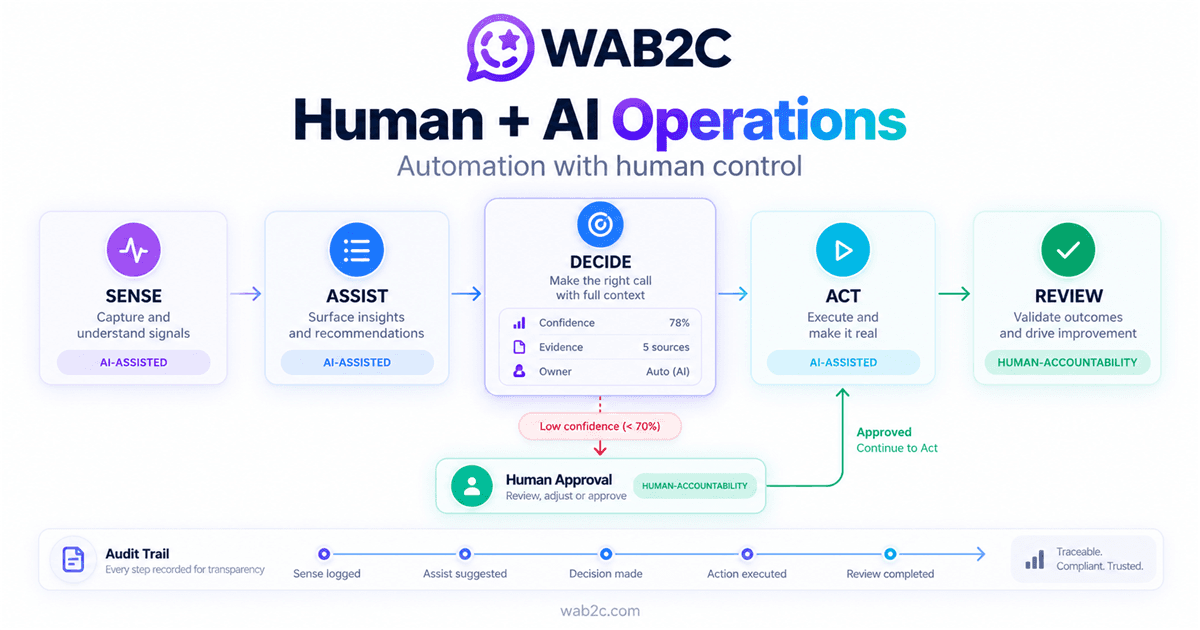
The work does not end when AI produces an answer. It ends when the outcome, ownership and correction are visible.
Receive a message, voice transcript, form or system event with approved context.
Summarise, classify, retrieve or draft inside a defined task boundary.
Apply confidence, risk, customer impact and authority rules to choose the path.
Execute, request approval or assign a human with the complete context package.
Compare outcome, correction and exception evidence to improve the control.
Human oversight calculator
A credible AI case subtracts the work needed to review decisions and resolve exceptions. Adjust every assumption to match your operation.
International reference frameworks
These standards can inform discovery, control design and evidence requirements. Their inclusion is a reference—not a claim that WAB2C or a customer deployment is certified.
ISO/IEC 42001:2023
Frames accountable policy, impact, lifecycle and continual improvement around enterprise AI use.
ISO/IEC 23894:2023
Informs how AI-specific risks can be identified, assessed, treated and monitored in context.
ISO/IEC 27001:2022
Provides a reference for risk-based controls around information, access and operational evidence.
Readiness checklist
Complete the checks, then send the result to yourself or ask WAB2C to guide the unresolved controls.
0 / 7
controls currently confirmed
Teams spent time reading long threads and manually identifying intent, urgency and the correct specialist.
AI summarised and classified approved fields; confidence, sensitive topics and customer requests activated human review.
Qualified owners received clearer context sooner while advice, exceptions and final commitments remained accountable.
Enterprise customer perspective
“WAB2C helped us introduce automation without losing human responsibility. Their team made escalation rules practical, connected operational context, and supported our people closely through each controlled rollout.”
Sumair Ahmed
CIO · EV Company
“The Human plus AI structure gave management clearer control over sensitive client communication. WAB2C’s team explained boundaries, approvals, evidence, and exception handling with genuine patience and practical support.”
Syed Abubakar
Head of IT · Accounting & Taxation Company
“Our agents gained useful summaries and faster next actions while remaining accountable for customer commitments. WAB2C supported the technical design closely and helped refine controls from real operating feedback.”
Bilal Saeed
CTO · Mobile Phone Repair Company
The reason to meet
In one focused discussion, frame the permitted task, approved evidence, confidence gate, human authority, prohibited action, review measure and controlled first release.
Decision FAQs
The answers define whether AI is a governed operating capability or an uncontrolled experiment.
A chatbot is one customer interface. Human + AI Operations defines which tasks AI may assist, recommend or execute; what evidence it may use; when a person must approve; how exceptions are owned; and how every material action is reviewed.
Review the autonomy modelSensitive, irreversible, regulated or high-impact commitments should remain with appropriately authorised people. The precise boundary depends on business risk, customer impact, legal obligations, evidence quality and the ability to reverse an action.
See the control contractThe design uses bounded tasks, approved sources, confidence gates, prohibited actions, human approval and evidence trails. These controls reduce risk but do not make AI infallible; monitoring and accountable review remain essential.
Follow the operating pathIt is a defined signal used with business rules to decide whether an output may assist, requires approval or must escalate. A threshold is not proof of correctness and should be validated against real examples and impact.
Explore confidence gatesWhere configured services and approved language workflows are available, transcription, translation, summarisation and drafting can support multilingual handling. Humans should review sensitive meaning, tone, commitments and low-confidence language output.
Explore multi-region operationsMeasure eligible work, assistance coverage, human review, exceptions, net hours returned, quality and customer outcomes together. Time saved without oversight, correction and outcome evidence is not a credible enterprise business case.
Use the oversight calculatorChat with our WAB2C experts
Get instant answers about WhatsApp API,
pricing, and features.
Available 24/7 • Response within 5 minutes