
Event envelope
event_id, event_type, occurred_at, schema_version, tenant reference and approved payload.
Governed event-driven integration
WAB2C helps enterprise teams design APIs and webhooks around verifiable trust, explicit semantics, idempotent processing, observability and controlled replay.
Signed and validated at the boundary
Duplicate-safe business actions
Fast acknowledgement with queued work
Observable retry, review and replay
The complete event picture
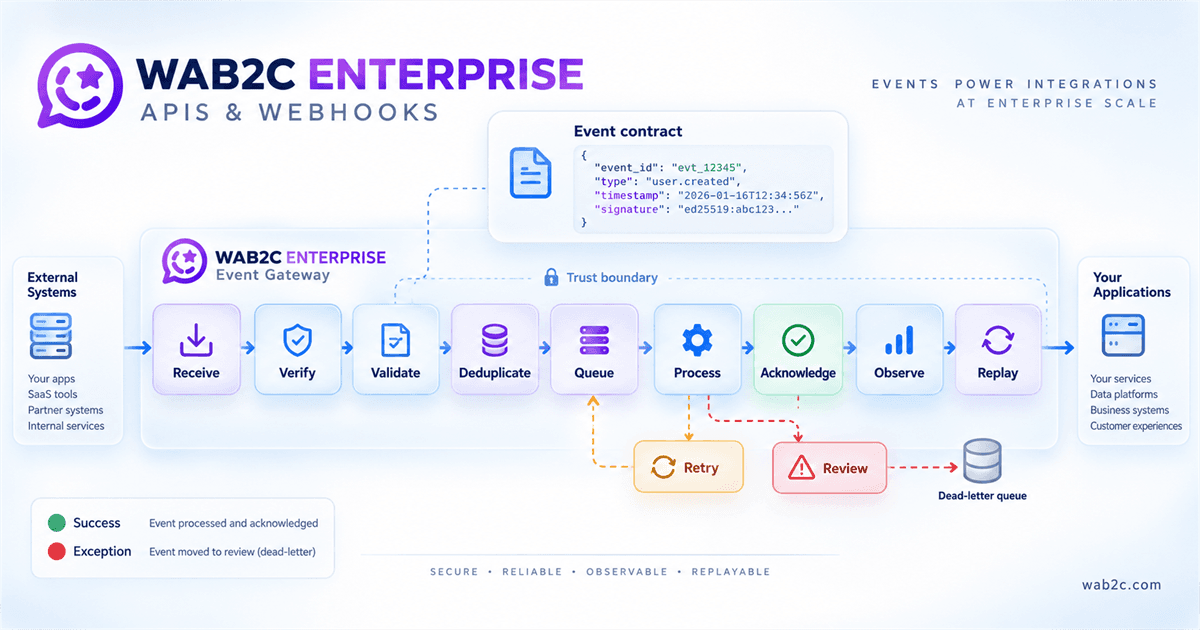
This visual is a separate architectural section—not hero decoration. It exposes the stages decision-makers should require before an event path is accepted for production.
Event contract lab
Select an interaction pattern to inspect the producer, envelope, receiver, acknowledgement, retry rule and evidence needed to operate it.
event_id, event_type, occurred_at, schema_version, tenant reference and approved payload.
Customer integration gateway or approved middleware.
Return a defined success response after durable acceptance—not after unsafe partial work.
Retry transient failure with bounded backoff; route permanent failure for review.
Correlation ID, signature result, schema result, processing state and final disposition.
Integration platform team
Production delivery lifecycle
The lifecycle makes trust, data integrity, queueing, acknowledgement, visibility and recovery explicit instead of leaving them as hidden implementation detail.
Expose the minimum approved endpoint surface.
Check trust evidence before accepting the sender.
Reject malformed or unsupported contracts clearly.
Use event identity to prevent repeated business work.
Separate edge acknowledgement from deeper processing.
Apply one owned business action with correlation.
Return success or error semantics the producer can use.
Measure latency, failure, backlog and final disposition.
Recover safely with preserved history and approval.
Version schemas, error semantics, examples and deprecation expectations so producers and consumers can evolve safely.
Separate sender verification, authorization, secret rotation, network controls and payload minimisation into reviewable decisions.
Promote contract and consumer changes through controlled environments with compatibility tests, rollback and named production ownership.
Event throughput and retry capacity model
This capacity model makes operating assumptions visible. It does not promise throughput or availability; production design still depends on architecture, infrastructure and external limits.
Current technical reference frameworks
These official references guide API contracts, HTTP behaviour, problem responses, portable event envelopes and security review. They are not a WAB2C certification claim.
OpenAPI 3.2.1
A current language-agnostic specification for discoverable API contracts, schemas, callbacks and security schemes.
RFC 9110
Defines request methods, status codes, representation semantics and the meaning clients and servers rely on.
RFC 9457
Provides a standard machine-readable structure for API error detail instead of inventing a new format for every endpoint.
CloudEvents 1.0.2
Offers an interoperable event description model across services, platforms and supported protocol bindings.
OWASP API Security Top 10 · 2023
A practical reference for common authorization, authentication, resource and business-flow risks in APIs.
Production readiness checklist
Complete the checks, then send the result to yourself or ask WAB2C to guide the unresolved API and webhook design.
0 / 7
event controls confirmed
Repeated status callbacks, delayed partner updates and route exceptions created conflicting customer answers and hidden recovery work.
Each milestone carried stable identity, schema, source time and correlation while duplicates and stale transitions were controlled.
Operations could see accepted, retried, unresolved and reconciled events before sending verified customer updates.
Enterprise customer perspective
“WAB2C gave our integration teams a clearer event model and practical ownership around failures. Their support helped us move beyond basic callbacks toward reliable, traceable business outcomes.”
Sumair Ahmed
CIO · EV Company
“The API discussion stayed focused on contracts, access and operating responsibility. WAB2C support made technical risks understandable to both IT and business reviewers before implementation decisions were made.”
Syed Abubakar
Head of IT · Accounting & Taxation Company
“WAB2C helped us design event handling that did not hide retries or exceptions. Their technical team supported testing, correlation and recovery in a way our operations team could actually use.”
Bilal Saeed
CTO · Mobile Phone Repair Company
The reason to meet
A 1:1 session can define the producer, schema, trust boundary, acknowledgement, idempotency, ordering, retry, dead-letter review, observability, replay and acceptance criteria for one representative event path.
Decision FAQs
The answers reveal whether the proposed event path can be trusted, observed and recovered—or merely works once in a demonstration.
An API call is usually a request for data or action initiated by a client. A webhook pushes an event to a subscribed endpoint when something happens. Enterprise designs often use both: webhooks signal change, while APIs retrieve or perform controlled work.
Inspect the event contractsNot necessarily. It may only confirm receipt. The contract should distinguish edge acceptance, queued processing and final business completion, with correlation and status evidence for each stage.
Review the delivery lifecycleUse stable event identity, idempotent business actions, source timestamps or versions, monotonic transition rules where appropriate, and a review path for conflicts. Never assume callbacks arrive exactly once or in perfect order.
Open replay and reconciliationApply server-side credentials, request verification, least privilege, schema and size validation, replay protection, rate awareness, protected logs, dependency timeouts and controlled secret rotation based on the agreed threat model.
Review technical referencesAt minimum: accepted volume, validation failure, duplicate rate, processing latency, retry backlog, unresolved failure, dead-letter age, downstream dependency health and reconciliation outcome—without exposing sensitive payloads unnecessarily.
See observe and replayModel average events, peak multiplier, payload size, first-attempt failure, retry recovery, duplicates, processing time and retention. The calculator below converts those assumptions into peak load, retry demand and retained data.
Use the event capacity modelChat with our WAB2C experts
Get instant answers about WhatsApp API,
pricing, and features.
Available 24/7 • Response within 5 minutes