
Evidence expected
Permission scope, audience rule, template, frequency decision, suppression check and campaign owner.
Purpose, permission, use and evidence
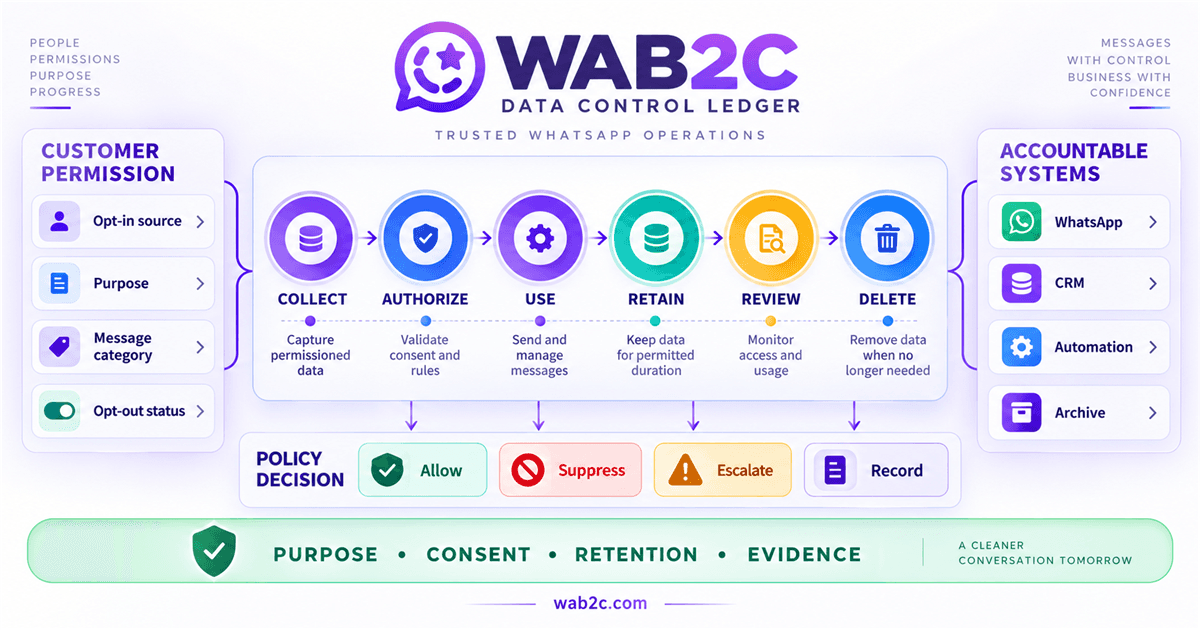
WAB2C Enterprise data controls connect customer permission, message purpose, policy decisions, access, automation, retention and accountable evidence across the conversation lifecycle.
Permission stays connected to purpose
Opt-out reaches every sending system
Automation preserves human accountability
Retention includes connected copies
Data-control lifecycle
The separate visual shows how permission sources, lifecycle decisions, accountable systems and evidence remain connected from collection through deletion.
Data-control decision studio
The interface separates business purpose, required evidence, allowed use, prohibited shortcuts, exception response and accountable ownership.
Permission scope, audience rule, template, frequency decision, suppression check and campaign owner.
Contact only the eligible audience through approved content and respect quality, frequency and opt-out controls.
Do not stretch service purpose, ignore opt-out or use automation to bypass audience governance.
Suppress ineligible contacts, record the decision and correct the source audience or permission data.
Data-control ledger
Customer data can move across WhatsApp, WAB2C, CRM, commerce, spreadsheets and analytics. Control means preserving the decision boundary across every authorised copy.
A permitted field can still be used for the wrong purpose.
Access control, permission, purpose, retention and message policy answer different questions. Enterprise governance keeps them connected.
Control 01
Connect every journey and field to an approved business purpose, accountable owner and current use boundary.
Control 02
Preserve where, when and how permission or customer initiation was established and what the person understood.
Control 03
Distinguish service, authentication, utility and marketing decisions using current policy and journey context.
Control 04
Expose only the fields needed by the role, automation, integration and reporting purpose.
Control 05
Apply defined periods, holds, deletion and cross-system reconciliation to conversation-related records.
Control 06
Review journeys when Meta policy, provider rules, law, purpose, data or connected systems change.
Consent inventory & retention workload model
This operational model is not a legal-compliance assessment. It exposes permission-evidence gaps, suppressions, preference changes, retention candidates and cross-system reconciliation effort using your assumptions.
Current privacy and messaging references
These official references inform privacy, data-protection and messaging-policy discussions. They do not replace legal advice, define every applicable obligation or imply WAB2C or customer certification.
ISO/IEC 27701:2025
Provides requirements and guidance for establishing, implementing, maintaining and improving privacy information management.
ISO/IEC 29100:2024
Provides common privacy terminology, actors, safeguarding considerations and privacy principles for ICT systems.
ISO/IEC 27018:2025
Offers guidance for controls protecting personally identifiable information processed by public-cloud providers acting as PII processors.
ISO/IEC 29151:2026
Provides objectives, controls and implementation guidance for protecting personally identifiable information.
WhatsApp Business Messaging Policy
The current Meta policy source for opt-in, opt-out, approved templates, service windows, automation and human-escalation expectations.
Compliance and data-control checklist
Complete the checks, then send the result to yourself or ask WAB2C to guide unresolved permission, classification, lifecycle and ownership decisions.
0 / 7
controls confirmed
Different teams held partial permission, preference and customer-context records with inconsistent campaign and retention decisions.
Purpose, permission evidence, message classification, suppression and lifecycle actions were assigned to named owners and systems.
Teams could explain eligibility, stop ineligible outreach and reconcile customer preferences without relying on one isolated list.
Enterprise customer perspective
“WAB2C helped us connect customer permission, message purpose and operational ownership. Their team support made suppression and policy decisions practical across sales and service.”
Sumair Ahmed
CIO · EV Company
“The data-control model gave our business and IT teams a shared language. WAB2C support clarified evidence, retention and cross-system responsibilities without making legal claims.”
Syed Abubakar
Head of IT · Accounting & Taxation Company
“Our team gained clearer controls for preferences, automation and customer records. WAB2C supported the operating details and helped keep exceptions visible to accountable owners.”
Bilal Saeed
CTO · Mobile Phone Repair Company
The reason to meet
A focused 1:1 session can map the business purpose, permission evidence, message classification, systems touched, access boundary, opt-out path, retention decision, accountable owners and unresolved legal or policy questions for one representative journey.
Decision FAQs
The answers reveal whether permission, purpose, policy and lifecycle decisions remain connected across people, automation and systems—or disappear after the first message.
No platform alone makes a business compliant. The enterprise and its advisers must determine applicable law, purpose, lawful basis, notices, permission, access, retention and customer-rights obligations. WAB2C can help translate approved decisions into an operating design.
Review the reference inputsEvidence should match the journey and applicable requirements, but commonly includes the source, wording or customer action, business purpose, scope, timestamp and identity reference. The current WhatsApp policy requires businesses to obtain opt-in and honour opt-out requests.
Inspect permission decisionsNo. Classification should follow the actual content, purpose, customer context and current Meta rules. A service label cannot turn unrelated promotion into an eligible service interaction or bypass approved-template requirements.
Review message classificationThe current WhatsApp policy expects a clear and direct path to human escalation when automation is used during the service window. The operating design should define the trigger, responsible team, context transfer, response expectation and evidence.
Review automation controlThere is no universal period. The enterprise should define periods by purpose, contract, legal obligation, operational need and risk, then apply them across connected copies, exports and systems while preserving documented holds and exceptions.
Model retention workloadThe affected journeys, templates, automation, permissions, notices and evidence should be reviewed by named owners. Meta may update its policies and can restrict access, so policy monitoring and change ownership belong in normal operations.
Use the data-control checklistChat with our WAB2C experts
Get instant answers about WhatsApp API,
pricing, and features.
Available 24/7 • Response within 5 minutes