
Baseline first
The starting operation, period, scope and source are documented before outcome language.
Transformation patterns in practice
Named claims and logos require documented permission
Metrics need a baseline, source and measurement period
Anonymised stories still explain design and operating change
Transferability is assessed—not promised
Story evidence lifecycle
The evidence lifecycle distinguishes baseline, operating design, adoption and outcome while customer identity, metrics and sensitive architecture remain permissioned.
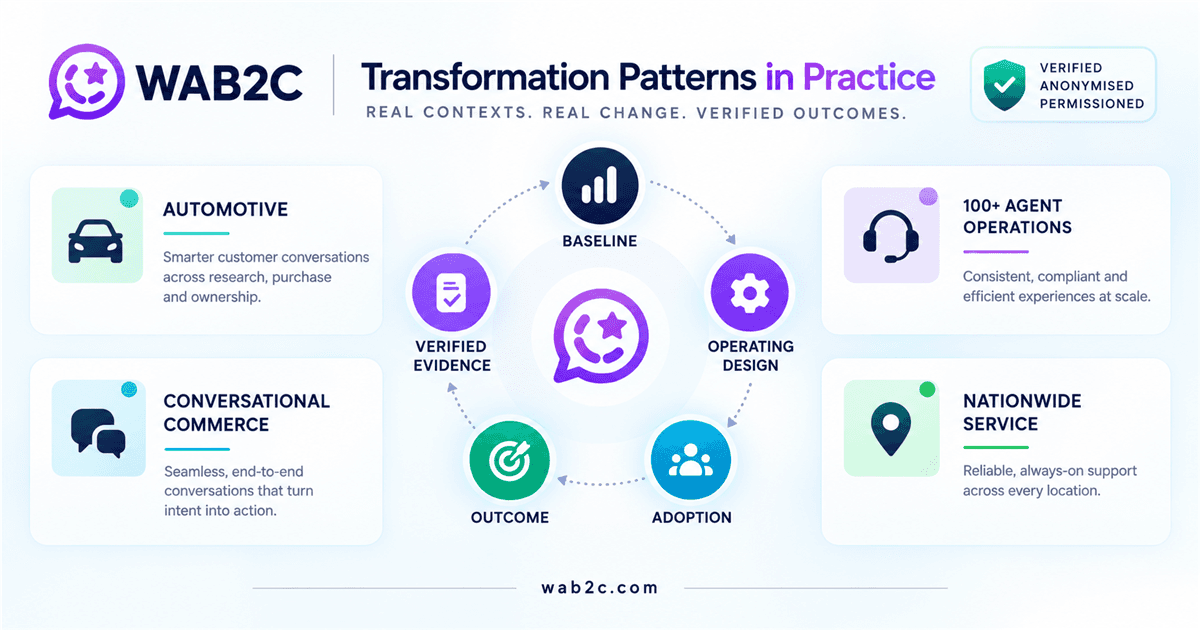
Transformation story navigator
Each story is an anonymised pattern until customer identity and metric permissions are documented. The value lies in the operating design and evidence questions you can reuse.
Evidence that should remain
Journey handoff design
Ownership and service record
Approved outcome measures
Decision risk
One-number convenience can still hide disconnected teams and systems if ownership is not designed.
Operating principles
The page turns a sales claim into observable responsibilities, evidence and decision boundaries.
The starting operation, period, scope and source are documented before outcome language.
Journey, ownership, systems, controls and adoption make the change understandable.
Identity, logos, metrics and quotes follow documented customer approval.
Similarities, dependencies and readiness are assessed before copying a pattern.
Discovery, sales, ownership and service around one customer lifecycle.
Open story Pattern 02Distributed teams with common ownership and reporting.
Open story Pattern 03Order intent coordinated through sales, operations and support.
Open story Pattern 04One message routed to the right regional or specialist team.
Open storyStory evidence & transferability
Separate confidence in the published evidence from similarity to your target operation. A strong story can still be a weak fit for a different context.
Current reference frameworks
These official sources provide management, service, quality, continuity, procurement or evidence context relevant to this page. Applicability, scope and conformance must be verified for the actual enterprise and agreement.
ISO 9001:2015
A quality-management reference for consistent delivery, process control, customer focus and continual improvement.
ISO 10004:2018
Guidance for defining and implementing processes to monitor and measure external customer satisfaction.
ISO 21502:2020
A project-management reference for outcomes, delivery practices, risk, change and post-implementation learning.
ISO/IEC 25010:2023
A product-quality reference for defining relevant quality characteristics and evaluation evidence.
Customer Stories readiness checklist
Complete the seven checks, send the result to yourself or ask WAB2C to guide unresolved operating, evidence and commercial decisions.
0 / 7
controls confirmed
The organisation wanted to explain transformation value without publishing customer-sensitive architecture, identities or unsupported headline metrics.
The story documented baseline, team and routing design, adoption, operating evidence, measurement definitions and permission boundaries as separate layers.
Decision-makers could see what changed and what they would need to validate in their own environment—without mistaking an anonymised pattern for a guaranteed result.
Enterprise customer perspective
“WAB2C gave our teams a clear operating path and dependable support. Their team stayed engaged, translated issues into actions and kept ownership visible through closure.”
Sumair Ahmed
CIO · EV Company
“The team support is practical and accountable. Scope, evidence and next decisions remain visible, which makes internal coordination and management review much easier.”
Syed Abubakar
Head of IT · Accounting & Taxation Company
“WAB2C supports the complete operating model, not only the interface. Their team helped us connect technical decisions with service ownership and measurable business outcomes.”
Bilal Saeed
CTO · Mobile Phone Repair Company
The reason to meet
A focused 1:1 session can map baseline, operating design, adoption, source systems, measurement definitions, permission boundaries and discovery questions for a transformation pattern relevant to your industry.
Decision FAQs
The answers are structured for human buyers, voice queries and search systems—then linked back to the exact operating model, calculator or evidence section that provides more detail.
Enterprise architecture, operating data, customer identity and commercial detail can be sensitive. An anonymised story can still explain the operating pattern while names, logos, quotes and metrics wait for documented permission.
Explore the story patternsA publishable outcome needs a defined metric, baseline, denominator, measurement period, source, scope, accountable owner and customer approval. Intended outcomes and directional observations should not be presented as verified results.
Review evidence referencesNo outcome should be guaranteed from a story. Results depend on baseline, journeys, adoption, team design, systems, data, provider dependencies and execution. Use the story to identify hypotheses and discovery questions.
Assess transferabilityUse metrics tied to the outcome and operating design: response, resolution, routing, completion, conversion, service demand, workload, adoption or quality. Each metric needs an exact definition and defensible attribution.
Use the evidence checklistThe architecture may transfer, but customer intent, regulation, service windows, language, systems, risk and success measures may differ. Assess operating and dependency similarity before reuse.
See transfer in practiceReference availability depends on customer permission and appropriate confidentiality. WAB2C can discuss relevant operating patterns and define what evidence or reference path is available during a qualified enterprise process.
Read customer perspectivesChat with our WAB2C experts
Get instant answers about WhatsApp API,
pricing, and features.
Available 24/7 • Response within 5 minutes