
01
Trigger
Verified order-created event
Event-driven enterprise execution
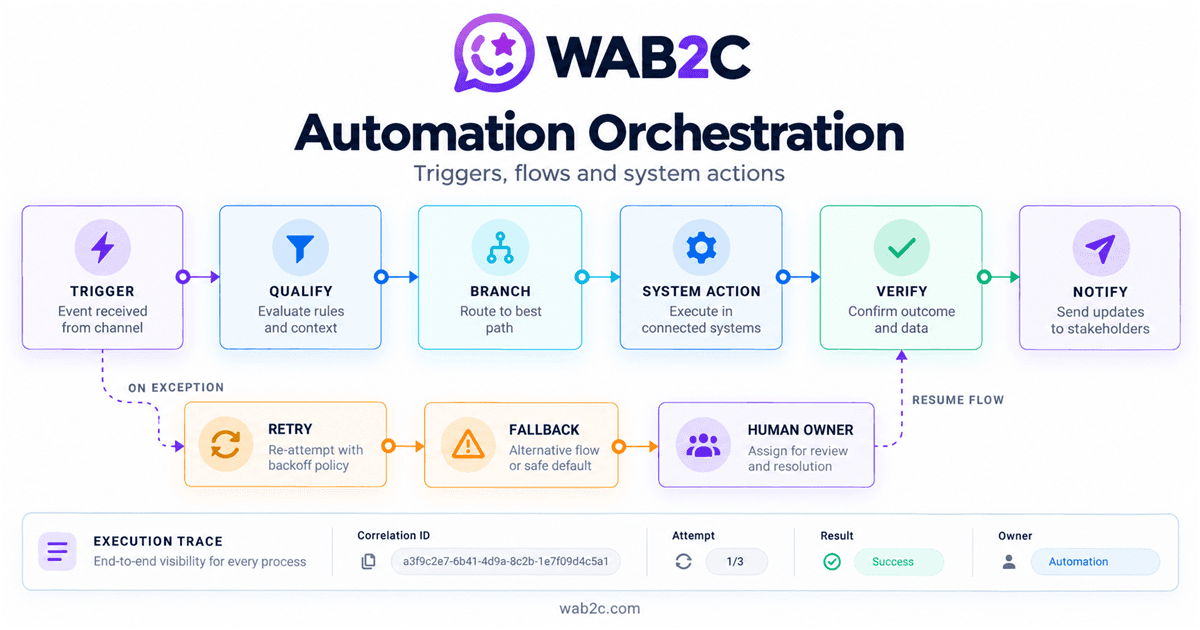
WAB2C coordinates customer intent, rules, forms, teams, APIs and systems as one observable flow—with safe retries, human fallbacks and proof that the work completed.
Verify before notifying the customer
Retry only safe and bounded actions
Prevent duplicates with business keys
Make every failure visible and owned
Scenario choreography studio
Choose a journey to see the trigger, decision path, system result and exception owner that make automation enterprise-ready.
Verified order-created event
Customer, channel, payment mode and required fields present
Prepaid, cash-on-delivery or manual verification
Create/update order record and assign the responsible branch
Authoritative order ID and owner returned
Send one confirmed status with the next step
The customer is notified only after the authoritative business outcome is verified—or receives a transparent owned exception update.
Execution trace
A trace joins one customer journey across channel events, rules, system calls, retries and final ownership without turning logs into the operating experience.
Correlation ID
a3f9…c5a1
Business outcome
Order verified
Live orchestration trace
One event chain · Asia/Karachi
10:24:03.184
order.created
Signature verified · correlation attached
10:24:03.228
eligibility.checked
Required fields and consent present
10:24:03.411
erp.order.upsert
Timeout · exponential backoff started
10:24:04.112
erp.order.upsert
Order PK-10428 · owner Lahore-03
10:24:04.268
customer.notified
Approved utility template · message ID stored
A trace supports investigation and reconciliation. Access, retention and customer-data visibility must still follow the enterprise security and governance model.
The orchestration control plane
Enterprise automation earns trust when duplicate, delayed, unavailable and partial outcomes have explicit treatment.
Use a stable business key so a repeated event cannot create the same business action twice.
Retry only safe operations, with attempt limits and increasing delay rather than message storms.
Stop waiting at a defined limit and move the work to a known fallback path.
Pace calls and queue demand when a provider or connected system reaches its permitted capacity.
Keep unresolved events with context, reason, next action and an accountable human owner.
Record event, decision, attempt, system response, owner and verified business outcome.
System-of-record discipline
WAB2C becomes the operating and orchestration layer. The enterprise still defines which system owns each customer, order, payment, case and outcome.
One rule that prevents expensive ambiguity
Every field has one authoritative owner, one permitted update path and one reconciliation method.
Customer channel
Messages start or continue a journey; they are not the authoritative order or payment record.
Orchestration layer
Coordinates rules, forms, assignments, approved messages, system calls, evidence and fallback.
Systems of record
Own authoritative customers, orders, inventory, invoices, cases and business outcomes.
Exchange boundary
Carry authenticated, validated events and responses with controlled failure handling.
Orchestration outcome calculator
This model distinguishes successful business outcomes from flow starts and includes the human cost of exceptions.
International reference frameworks
These standards can guide service, continuity and information-control discussions. They are references—not a claim that WAB2C or a customer deployment is certified.
ISO/IEC 20000-1:2018
Informs planned design, transition, delivery, measurement and continual improvement of managed services.
ISO 22301:2019
Provides a reference for continuity objectives, disruption response, recovery and organisational resilience.
ISO/IEC 27001:2022
Frames risk-based controls for information, identities, access, integrations and operational evidence.
Readiness checklist
Complete the checks, then send the result to yourself or ask WAB2C to guide the unresolved architecture.
0 / 7
orchestration controls confirmed
Service-due demand, customer replies and workshop availability moved through separate manual coordination steps.
The due event started qualification, availability lookup, slot request, confirmation and an owned exception path.
Customers received verified next steps while teams could trace failures, retries, appointments and unresolved work.
Enterprise customer perspective
“WAB2C connected service events, customer messages, team ownership, and system actions into one controlled path. Their support team stayed involved through testing, exceptions, and the production handover.”
Sumair Ahmed
CIO · EV Company
“The orchestration approach made every trigger, data field, approval, and failure path easier to govern. WAB2C’s team supported our technical review carefully and explained the operating implications clearly.”
Syed Abubakar
Head of IT · Accounting & Taxation Company
“We gained clearer execution traces and fewer manual handoffs across customer service workflows. WAB2C provided responsive technical support and helped our team design safe retries and accountable fallbacks.”
Bilal Saeed
CTO · Mobile Phone Repair Company
The reason to meet
A 1:1 session can define the business event, required data, authoritative system, branch rules, safe actions, proof of completion, retry policy and human exception owner.
Decision FAQs
The answers reveal whether a flow merely starts—or reliably completes accountable business work.
A chatbot handles an interaction. Orchestration coordinates the complete business execution: trigger validation, rules, branching, system actions, verification, customer communication, retries, exceptions and accountable ownership across connected systems.
Explore complete scenariosThe design applies safe retry rules, backoff, timeout limits and a controlled fallback. Unresolved work enters a visible failure queue with the event context, attempts, reason, next action and named human owner.
Review the control planeThe orchestration uses a stable idempotency or business key and verifies prior execution before repeating an action. The exact implementation depends on supported source and destination systems and must be tested with replay scenarios.
See idempotency controlYes. A designed human fallback packages the customer conversation, captured form data, system responses, failure reason, attempted actions and required next step, then starts ownership and service timing for the qualified team.
Inspect the execution traceWAB2C coordinates work, while the enterprise defines the authoritative system for each record and outcome—such as ERP for orders, CRM for opportunities, or a service platform for cases. Reconciliation protects that boundary.
Review system boundariesMeasure successfully verified outcomes, manual coordination removed, exception effort, duplicate actions prevented, completion quality and customer impact. Counting flow starts or messages sent does not prove the business work completed.
Use the orchestration calculatorChat with our WAB2C experts
Get instant answers about WhatsApp API,
pricing, and features.
Available 24/7 • Response within 5 minutes